
No — an ovulation test cannot reliably determine pregnancy, because it detects a different hormone from the one a pregnancy test looks for. An ovulation test (also called an ovulation predictor kit, or OPK) measures luteinising hormone (LH), the hormone that surges 24 to 36 hours before ovulation. A pregnancy test measures human chorionic gonadotropin (hCG), the hormone produced after implantation. The two tests look similar, use urine in the same way, and can both show two lines — but a positive ovulation test is not a positive pregnancy test, and using one as the other leads to wrong answers in both directions.
What an Ovulation Test Actually Detects
An ovulation test detects the LH surge that triggers ovulation. The central entity here is the LH surge: a sharp rise in luteinising hormone, produced by the pituitary gland, that causes a mature follicle in the ovary to release an egg. In a typical cycle, LH stays low for most of the follicular phase, then spikes to roughly 25 to 40 milli-international units per millilitre (mIU/mL) or higher for 12 to 24 hours, and ovulation follows about 24 to 36 hours after the surge begins. Most ovulation tests are designed to turn positive when urinary LH crosses a threshold of about 25 mIU/mL, which is why the test line must be as dark as, or darker than, the control line to count as positive — unlike a pregnancy test, where any second line, however faint, counts.
That threshold design is the first reason an ovulation test fails as a pregnancy test. Ovulation tests are calibrated to a hormone that rises and falls every cycle in every ovulating person, pregnant or not. A positive result therefore means "an LH surge is happening now," not "you are pregnant." It can also mean several other things, as the next sections show, which is why no fertility guideline recommends an ovulation test for pregnancy detection.
Why an Ovulation Test Can Show Positive During Pregnancy
An ovulation test can show positive during pregnancy, and the reason is a quirk of hormone chemistry: LH and hCG share an identical alpha subunit. The test's antibodies are built to recognise LH, but hCG is similar enough in structure that high levels of hCG can cross-react and trigger a positive ovulation test. This is the grain of truth behind the internet claim that "an OPK can detect pregnancy early." It is real, in the sense that cross-reactivity happens — but it is not useful, because the same cross-reactivity also fires at ovulation, in other hormonal states, and at hCG levels that have nothing to do with a viable pregnancy.
The timing argument also fails. Pregnancy tests detect hCG from about 10 to 14 days past ovulation (DPO), once implantation has happened and hCG has risen above roughly 25 mIU/mL. An ovulation test has no such anchor: it cannot tell you whether its positive line comes from an LH surge, from hCG cross-reactivity, or from a naturally high baseline LH. A test that can be positive for three different reasons on the same day is not a test at all — it is a coin toss with extra steps. If you want to know when a real pregnancy test becomes reliable, a pregnancy test timing calculator works from your ovulation or period dates instead of from a hormone it was never built to read.
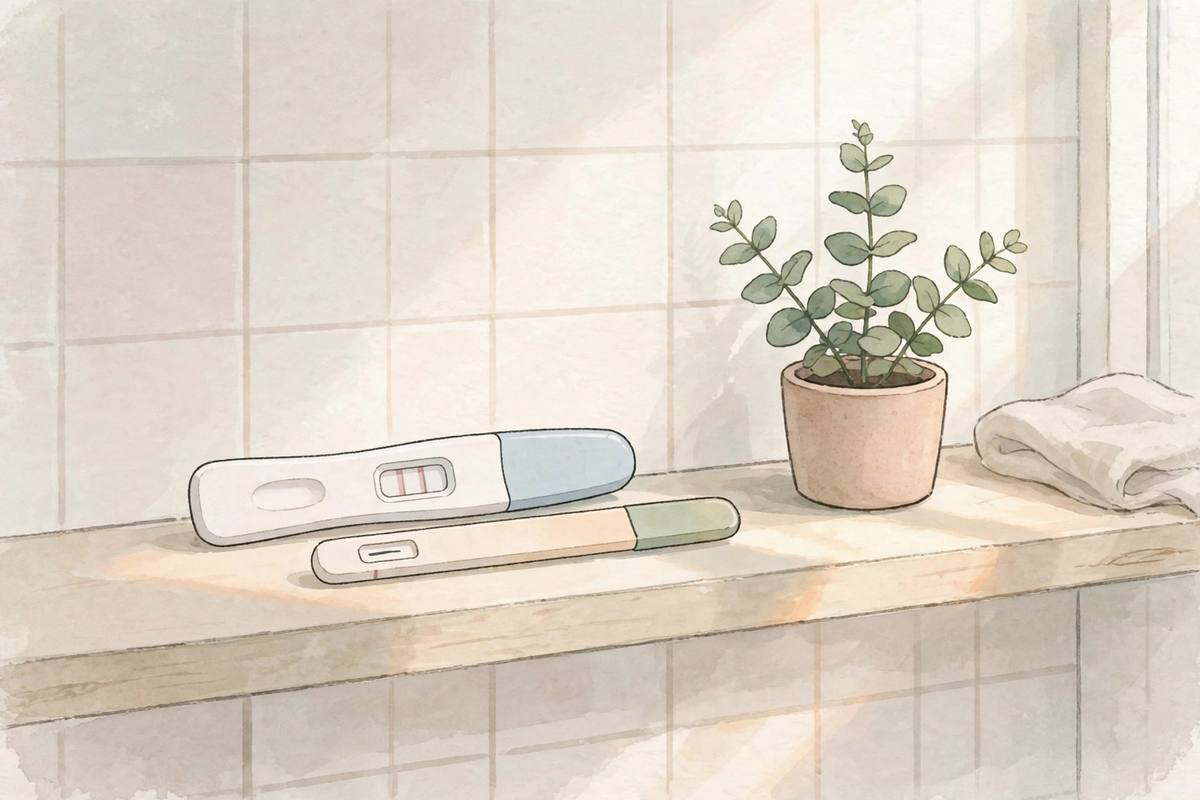
When an Ovulation Test Gives a False Positive for Pregnancy
An ovulation test gives a false "pregnancy" reading in several common situations, and recognising them is the fastest way to see why the shortcut fails. First, and most obviously, it is positive at ovulation itself: anyone testing around their fertile window will see a positive OPK while not pregnant, because that is exactly what the test is designed to do. Second, people with polycystic ovary syndrome (PCOS) often have chronically elevated LH, so their ovulation tests can stay positive for days at a time or show positives in most cycles regardless of pregnancy. Third, LH rises again in perimenopause, so ovulation tests become unreliable for pregnancy detection in the late 40s for a hormonal reason that has nothing to do with conception.
Medications add a fourth trap. Fertility drugs that contain hCG (trigger shots such as Ovidrel) will make an ovulation test positive for days after injection, because the injected hCG cross-reacts just as pregnancy hCG does. The same applies to a recent pregnancy loss or a chemical pregnancy: hCG lingers in the body for days to weeks after a loss, so an ovulation test can stay positive while no viable pregnancy exists. This is the most painful version of the false positive, because it can look like reassurance at exactly the moment when a proper hCG test and a clinician's guidance are needed. A guide to chemical pregnancy explains why hCG can be present without a continuing pregnancy, and why timing and repeat testing matter more than any single line.
What a Pregnancy Test Detects Instead
A pregnancy test detects hCG, and hCG is specific to pregnancy in a way LH is not. The central entity here is hCG: a hormone produced by the cells that will become the placenta, starting shortly after a fertilised egg implants in the uterus, usually 6 to 12 days past ovulation. Once implantation happens, hCG roughly doubles every 48 hours in early pregnancy — from about 25 mIU/mL at the first detectable point to hundreds by the missed period and thousands by week 5 or 6.
This is why the two tests have opposite rules for reading lines. On a pregnancy test, any visible test line counts as positive, because even a faint line means hCG above the threshold is present. On an ovulation test, only a line as dark as the control counts, because LH is always present at low levels and the test must distinguish a surge from background. People who apply pregnancy-test reading rules to an ovulation test — "any second line means positive" — will call many ordinary LH fluctuations positive, and people who apply ovulation-test rules to a pregnancy test risk dismissing a real early positive as "too faint." Reading the right test by the right rule matters, and the guide to reading a Clearblue pregnancy test walks through line versus digital results in detail.
A Worked Timeline: Ovulation Test Versus Pregnancy Test
A worked timeline makes the difference concrete. Take a 28-day cycle with ovulation on day 14. An ovulation test turns positive around day 12 or 13, when the LH surge begins, and ovulation follows on day 14. If conception happens, implantation occurs roughly 6 to 12 days later — days 20 to 26 of the cycle — and hCG becomes detectable around day 24 to 28, which is 10 to 14 days past ovulation. A pregnancy test taken on day 28, the expected period day, is therefore testing for a hormone that has only existed for a few days. An ovulation test taken on that same day 28 could be positive for a completely different reason: a new LH rise, a lingering hCG cross-reaction, or a naturally high baseline — and it cannot distinguish among them.
The practical rule follows directly. If your period is late and you want to know whether you are pregnant, use a pregnancy test — ideally on first morning urine, when hCG is most concentrated, and repeated 48 hours later if the first result is negative but the period still has not arrived. If you want to know when you ovulate, use an ovulation test, and confirm the fertile window with an ovulation date calculator.
Can an Ovulation Test Ever Be Useful in Early Pregnancy?
An ovulation test has one narrow, legitimate use in early pregnancy, and it is not as a pregnancy test: it can help confirm that ovulation happened at all in a cycle where conception was attempted. In fertility tracking, a positive OPK followed by a sustained basal body temperature rise is a reasonable sign that ovulation occurred, which helps date a pregnancy later. Once a pregnancy test is positive, the ovulation test's job is done — it adds no information about whether the pregnancy is progressing, because LH levels after conception do not track viability the way hCG does. An hCG level checker is the right tool for understanding early hCG ranges, and even that is a guide, not a diagnosis: only serial blood hCG measurements and ultrasound can confirm how a pregnancy is developing.
There is also a plain cost argument. Ovulation tests are usually bought in bulk packs of 20 to 50 strips, which makes them feel "free" compared with a pregnancy test bought singly — and that perceived cheapness drives the shortcut. But a free answer that is wrong half the time costs more in worry and wasted days than the few dollars a proper pregnancy test costs.
When to Test, and When to Ask a Clinician
When to test for pregnancy is a timing question with a clear answer: test from the day of your expected period, or from 14 days past ovulation, using a pregnancy test, and retest after 48 hours if the result is negative and the period is still absent. Test earlier only if you accept a higher chance of a false negative, because hCG may not yet have crossed the 25 mIU/mL threshold. A positive pregnancy test, even a faint one, should be followed by booking prenatal care — and if you are unsure how far along you are, a weeks pregnant calculator can estimate gestational age from your last period or conception date.
Ask a clinician sooner if you have a positive pregnancy test followed by bleeding or severe one-sided pain, if your period is more than two weeks late with repeated negative pregnancy tests, or if ovulation tests are positive in nearly every cycle (a pattern that can point to PCOS or another hormonal condition worth investigating). If you are tracking days after ovulation, the guide to DPO explains why a negative result at 9 DPO differs greatly from one at 14 DPO.
The Bottom Line on Ovulation Tests and Pregnancy
The bottom line is simple: an ovulation test cannot determine pregnancy. It measures LH, which surges before ovulation, stays elevated in conditions like PCOS, and can be mimicked by hCG cross-reactivity — so a positive ovulation test during pregnancy is a chemistry coincidence, not a diagnosis. A pregnancy test measures hCG, the hormone that only a pregnancy produces, and it becomes reliable from about 10 to 14 days past ovulation. Use each test for the question it was built to answer, read each by its own line rules, and when the question is "am I pregnant?", reach for the pregnancy test, not the ovulation strip.