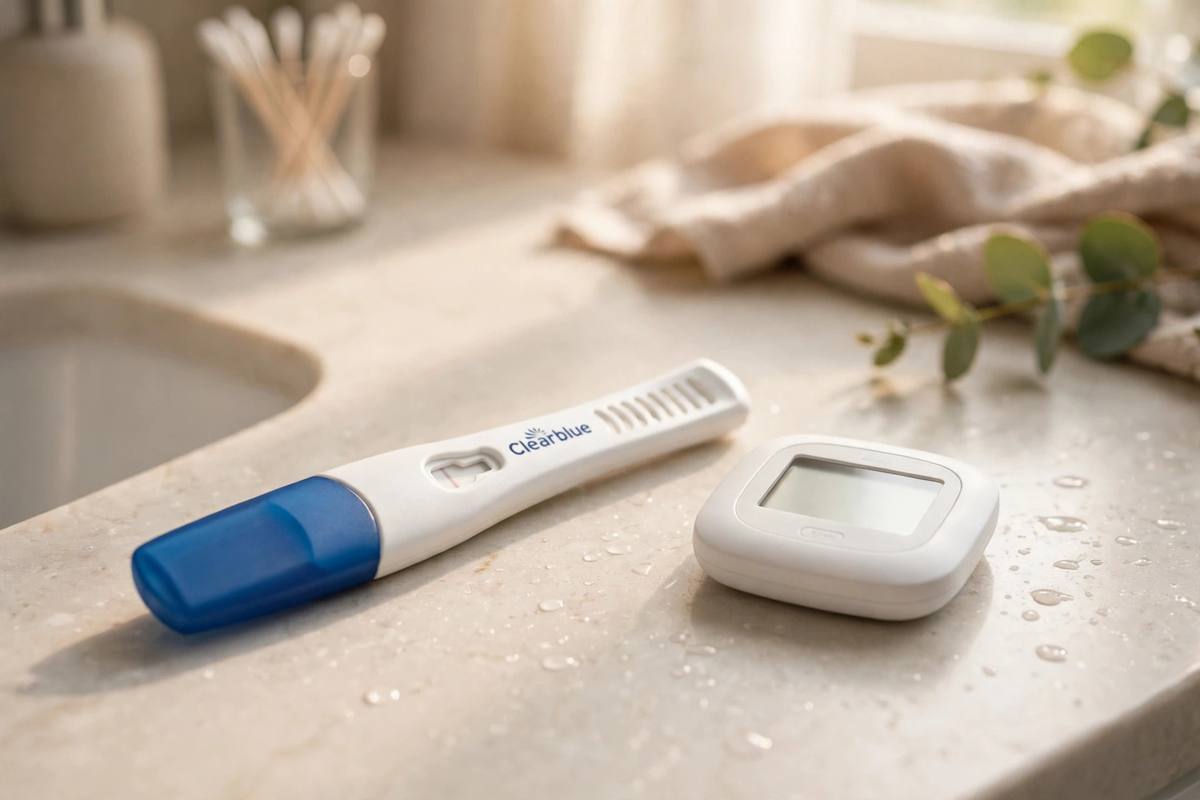
A Clearblue pregnancy test is read in one of two ways, depending on the type you bought: on a line test, two lines means pregnant and one line means not pregnant; on a Digital test, the screen spells it out in words — "Pregnant" or "Not Pregnant". In both cases the result only counts if you read it inside the test's stated time window and the control line (or control symbol) has appeared. Updated 2026: this guide walks through both formats, explains faint lines and the weeks indicator, and covers the mistakes that make a result hard to trust.
The most common confusion is which result you are looking at. Clearblue sells line tests and Digital tests that look similar in the box but read very differently: a Digital test never shows lines, and a line test never shows words.
The Two Clearblue Formats, and Which One You Have
Clearblue pregnancy tests fall into two families: line tests and Digital tests. A line test shows its result as coloured lines in a small window; a Digital test shows its result as words on a display screen.
Line tests: Clearblue Rapid Detection and Early Detection
Line tests are the familiar stick format. After you hold the absorbent tip in urine (or dip it in a collected sample), coloured lines appear in the result window. Clearblue's Early Detection test can detect pregnancy from 6 days before your missed period, while the Rapid Detection test is designed for use from the day of your missed period. The difference matters for sensitivity: the Early Detection test detects human chorionic gonadotropin (hCG) — the pregnancy hormone — at about 10 mIU/mL, while standard tests generally detect it at about 20 to 25 mIU/mL.
Digital tests: Clearblue Digital and Digital with Weeks Indicator
Digital tests replace lines with words. The standard Clearblue Digital displays "Pregnant" or "Not Pregnant" on its screen, usually within 1 to 5 minutes. The Digital with Weeks Indicator also estimates weeks since conception, shown as "1–2", "2–3", or "3+". That figure counts from conception, not from your last period, so it runs about 2 weeks behind the gestational age your doctor will quote. Clearblue states it agrees with later ultrasound dating in about 93% of cases.
How to Read a Clearblue Line Test, Step by Step
A Clearblue line test is read by comparing two lines in the result window: the control line and the test line. Read the result within 10 minutes of testing, and ignore anything that appears after that window.
Step 1: Check the control line first
The control line tells you the test worked. On most Clearblue line tests it appears as a vertical line on one side of the window, and it must be present for any result to count. If no control line appears, the test is invalid — discard it and test again with a new stick. A missing control line usually means too little urine reached the strip or the test was damaged or expired; the question of whether pregnancy tests expire covers how to check the date.
Step 2: Look for the test line
If the control line is present, look for the second line — the test line. Two lines, even if the second is faint, means pregnant: the test has detected hCG in your urine. One line — the control line alone — means not pregnant, provided you tested at the right time.
Step 3: Note the colour and the timing
A true test line carries colour — pink on most Clearblue tests, blue on the blue-dye versions — and it appears within the read window. A thin grey or colourless streak that shows up after 10 minutes is most likely an evaporation line, left behind as urine dries on the strip, and it does not count as a positive. This is the single most common reason a line test is misread, and it is why the instructions say to set a timer and read the result once, inside the window, rather than checking the stick again an hour later.
Timing matters as much as technique. Testing before hCG has risen enough produces a false negative far more often than a faulty stick does, so if your result is negative but your period still has not arrived, the When to Take a Pregnancy Test Calculator can work out the earliest reliable day to test from your cycle dates. Retesting 48 hours later with first-morning urine settles most doubtful early results, because hCG roughly doubles every 48 to 72 hours in a healthy early pregnancy.
What Does a Faint Line on a Clearblue Test Mean?
A faint line on a Clearblue test means pregnant, as long as it has colour, appeared within the 10-minute read window, and the control line is present. A faint line does not mean a weak pregnancy or a problem: it usually means hCG is still low, because you tested early.
Faintness tracks hCG level, not pregnancy health. A few days before your missed period, hCG may sit just above a test's 10 to 25 mIU/mL threshold — enough to trigger a line, but only a pale one. First-morning urine gives the strongest line, because it is the most concentrated; urine diluted by drinking a lot of fluid beforehand gives a fainter one. If you want to watch the line darken over several days, the pregnancy test line progression calculator explains how line darkness relates to rising hCG, and why a line that gets lighter over 48 hours is worth discussing with your clinician.
How to Read a Clearblue Digital Test
A Clearblue Digital test is read from its screen, not from lines. The screen displays "Pregnant" or "Not Pregnant" in words, and there is nothing to interpret: no faint lines, no colour judgement, no evaporation-line problem, because a Digital test does not show lines at all.
The Digital result, and how long it stays
The result usually appears within 1 to 5 minutes and then stays on the screen — Digital tests hold their result, so you can re-read it later without the evaporation-line worry that applies to line tests.
Reading the Weeks Indicator
If you used the Digital with Weeks Indicator and it shows "Pregnant", the screen adds a weeks estimate: "1–2", "2–3", or "3+". Add roughly 2 weeks to get the gestational age your doctor uses — "1–2" is about 3 to 4 weeks pregnant by the medical count, and "3+" is about 5 or more weeks pregnant. This is the insight most guides skip, and it explains why the number on the screen often looks "too low" compared with what a clinic tells you. If the indicator and your dates disagree by a wide margin, an ultrasound — not another home test — settles it.
What "Not Pregnant" means on a Digital test
"Not Pregnant" means the test did not detect hCG at or above its threshold, which for most Digital tests is about 25 mIU/mL. It does not prove you are not pregnant: if you tested before your missed period, hCG may simply not have risen past 25 mIU/mL yet. Wait 48 hours and test again, or switch to an Early Detection line test with its lower 10 mIU/mL threshold. If your period is already late and repeated tests stay negative, that pattern itself is worth a clinician's input.
What Can Make a Clearblue Result Misleading?
Most misleading Clearblue results have an explainable cause, not a faulty test. Home pregnancy tests from major brands are about 99% accurate from the day of a missed period when used as directed, per the standard FDA-cleared claim echoed in American College of Obstetricians and Gynecologists (ACOG) patient materials — so when a result looks wrong, the cause is usually timing, technique, or leftover hCG.
- Reading after the window. Anything appearing on a line test after 10 minutes is not a result. Set a timer and read once.
- An expired or damaged test. Heat, moisture, and past-expiry sticks can produce faint marks and invalid controls. Store tests at room temperature and check the date.
- Testing too early. Before implantation, roughly 6 to 12 days after ovulation, there is no hCG to detect at all. A negative before your missed period is often just an early negative.
- hCG from fertility treatment or a recent pregnancy. An hCG trigger shot (typically 5,000 to 10,000 IU) stays detectable for roughly 10 to 14 days, and hCG after a miscarriage or birth can take weeks to fall to zero. A positive in those windows may reflect leftover hormone, not a new pregnancy.
- A very early pregnancy loss. A chemical pregnancy — an embryo that implants and then stops developing within about a week of a missed period — produces a real positive that then fades, because hCG falls instead of doubling. The guide to What Is a Chemical Pregnancy? explains this, and the question of whether you can get a wrong positive pregnancy test covers the full list of causes with a 72-hour check.
If you are unsure about a result, the most useful number is not on the stick at all: it is your hCG level. A blood test quantifies hCG precisely, and the hCG level checker shows the typical ranges by week.
When to Retest, and What to Do Next
Retest if any of these apply: you tested before your missed period and got a negative; the control line never appeared; you read the result after the window; or the line was faint and you want confirmation. Retest 48 hours later with first-morning urine, using a new test, and read it once inside the window. With hCG doubling every 48 to 72 hours, a genuine early positive should be visibly darker, while an evaporation line will not reproduce.
If your retest is clearly positive, the next step is a clinician visit to confirm the pregnancy and date it — home tests confirm hCG, not the location or viability of the pregnancy, and only an ultrasound can do that. The pregnancy week by week guide walks through what happens at each week from here.
The bottom line is reassuringly simple: on a Clearblue line test, two coloured lines inside 10 minutes means pregnant, even if the second line is faint; on a Digital test, the words on the screen are the result, and the weeks indicator counts from conception, about 2 weeks behind the doctor's count. Read once, inside the window, trust the control line — and when in doubt, retest in 48 hours. If you are still deciding when to test, the When to Take a Pregnancy Test Calculator works out your earliest reliable test day.