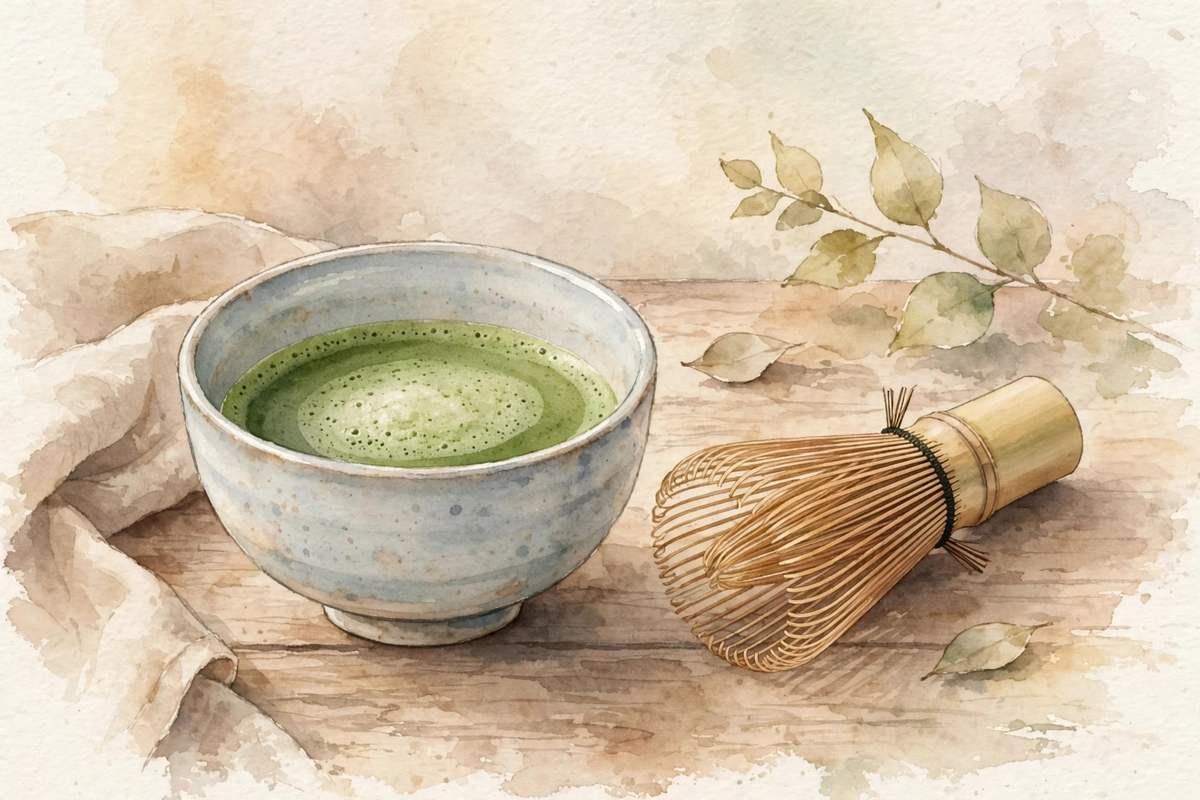
Yes — matcha is safe during pregnancy in moderation, at about 1 serving a day. The reason for the limit is caffeine: a standard matcha serving (about 2 grams of powder whisked into water) contains roughly 60 to 70 mg of caffeine, about double a cup of brewed green tea, so one matcha already uses about a third of the 200 mg daily caffeine ceiling the American College of Obstetricians and Gynecologists (ACOG) advises for pregnant women. Updated 2026: brewed matcha in normal amounts is fine, but large café servings, matcha extracts, and matcha-flavoured energy products are a different story.
Matcha is often treated as "just green tea", and that is where the counting goes wrong. Matcha is powdered whole green tea leaf, whisked into water and drunk in full — not leaves steeped and discarded. You therefore consume everything in the leaf: more caffeine, more of the antioxidant EGCG (epigallocatechin gallate), and more of anything else the leaf picked up from the soil.
How Much Caffeine Is in Matcha?
A standard matcha serving contains roughly 60 to 70 mg of caffeine, compared with about 20 to 45 mg in a 240 ml cup of brewed green tea. The gap comes from the whole-leaf difference: brewed tea only extracts part of the leaf's caffeine into the water, while matcha delivers the entire leaf.
What counts as one serving
One serving means about 2 grams of matcha powder — roughly 1 level teaspoon — whisked into 60 to 80 ml of hot water. Café matcha lattes often break this rule quietly: a large latte can use a double serving of powder (about 4 grams), pushing caffeine toward 120 to 140 mg in a single drink, before any added sugar is counted. Ask how many scoops a café uses, or make matcha at home where you control the dose.
Where one matcha fits in the 200 mg day
ACOG advises keeping caffeine below 200 mg a day during pregnancy, counting every source. One standard matcha (about 65 mg) fits comfortably; one large double-scoop latte (about 130 mg) leaves almost no room for anything else. A realistic day with matcha looks like this: 1 matcha (about 65 mg) + 1 small square of dark chocolate (about 12 mg) = about 77 mg, well under the ceiling.
Now compare a day that crosses the line without any coffee: 1 large matcha latte (about 130 mg) + 1 cup of black tea (about 47 mg) + 1 can of cola (about 34 mg) = about 211 mg, over the limit. Matcha alone is rarely the problem — stacked sources are. If you drink other caffeinated drinks, a pregnancy caffeine calculator adds up your full day in seconds.
Matcha vs Green Tea: Why the Whole Leaf Changes the Rules
Matcha and brewed green tea come from the same plant, Camellia sinensis, but they are not interchangeable in pregnancy counting — the answer for brewed green tea (1 to 2 cups a day) does not transfer directly to matcha, as the separate question of whether green tea is safe during pregnancy shows.
Caffeine, EGCG, and leaf compounds compared
Brewed green tea delivers about 20 to 45 mg of caffeine and roughly 50 to 100 mg of EGCG per cup, because the leaves are discarded after steeping. Matcha delivers about 60 to 70 mg of caffeine and proportionally more EGCG per serving, because the whole leaf is consumed.
The whole-leaf point cuts both ways. Matcha also delivers more L-theanine, the amino acid that gives green tea its calm, focused feeling and partly softens caffeine's jittery edge — one reason matcha's energy feels smoother than coffee's. For pregnancy, the grade (ceremonial vs culinary) matters less than the dose: both carry similar caffeine per gram.
EGCG, Folate, and the First Trimester
Matcha's main active compound is EGCG, a catechin antioxidant — and the source of the most-cited caution about green tea in pregnancy: laboratory studies have shown EGCG can interfere with the body's use of folate, the B vitamin that protects against neural tube defects in early pregnancy.
Here is what the evidence actually says, kept in proportion:
- The folate interaction comes from cell and animal studies using concentrated EGCG doses far above what a single matcha delivers: laboratory doses run into hundreds of milligrams, while one matcha serving contains roughly 100 to 200 mg of EGCG.
- No human study has shown that 1 serving of matcha a day causes folate deficiency or birth defects in women taking prenatal folic acid.
- Folate matters most in the first 12 weeks, when the neural tube closes, and a daily prenatal vitamin with 400 to 800 micrograms of folic acid (the ACOG-recommended dose) covers the gap.
The honest summary: the EGCG-folate concern is real in a laboratory, but at one-serving-a-day doses with a prenatal vitamin, it is a reason for moderation, not avoidance. If you drink matcha daily, be strictest in the first trimester, when folate demand peaks and the neural tube is forming.
Matcha and Iron Absorption: The Same Timing Rule as Green Tea
Matcha contains tannins, plant compounds that bind to non-heme iron — the iron in plant foods, beans, and supplements — and reduce absorption. Drinking matcha with a meal can cut non-heme iron absorption by 50 to 70% for that meal. This matters because iron needs jump from 18 mg a day to 27 mg a day in pregnancy (National Institutes of Health, Office of Dietary Supplements), and iron-deficiency anaemia affects roughly 1 in 4 pregnant women worldwide (World Health Organization, 2023 estimates). The fix is timing, not abstinence:
- Drink matcha at least 1 hour before or 2 hours after iron-rich meals and your prenatal vitamin.
- Pair iron-rich foods with vitamin C, which boosts non-heme iron absorption and partly offsets the tannin effect.
- If you take an iron supplement, take it with water or juice, never with matcha.
Lead in Matcha: What to Know, and How to Choose
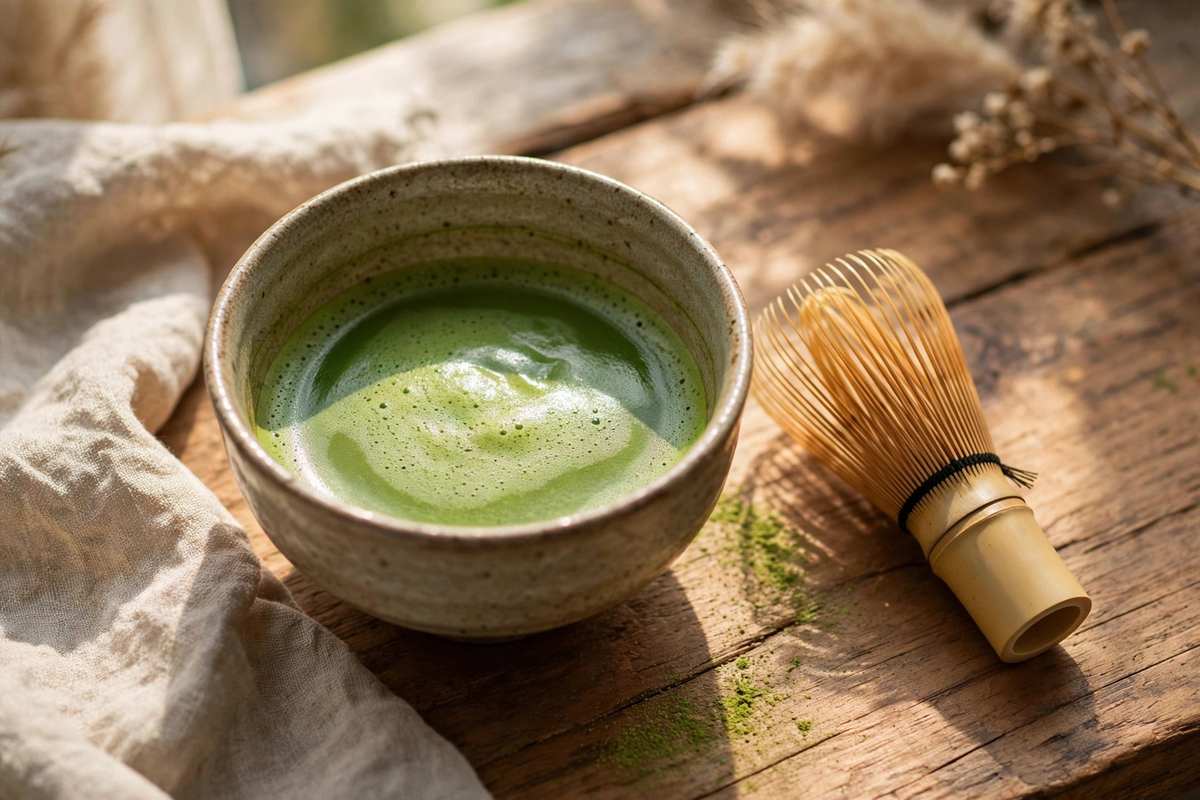
Because matcha is whole ground leaf, anything present on or in the leaf ends up in your cup — including lead, which tea plants can absorb from soil. This concern barely applies to brewed tea, where most of the leaf is thrown away.
The risk needs proportion. Studies of matcha powders have generally found lead levels well below food limits, and a single daily serving from a reputable brand is not a documented cause of lead poisoning in pregnancy. But lead has no known safe threshold in pregnancy, so buy from brands that publish heavy-metal testing, avoid unlabelled powders, and keep to 1 serving a day.
Matcha Lattes, Sweets, and Products to Watch
Not everything labelled "matcha" behaves like a bowl of matcha, and the differences are large enough to change your count.
Café matcha lattes
A café matcha latte is usually matcha plus milk plus sweetener, and the sweetener is often the bigger issue: a large sweetened latte can contain 20 to 30 grams of added sugar on top of a double serving of powder. Order unsweetened with a single serving — the pregnancy calorie calculator can put a sweetened latte in context.
Matcha sweets, ice cream, and energy drinks
Matcha-flavoured cakes and ice cream contain very little actual matcha and negligible caffeine — they count as sweets, not servings. Matcha energy drinks are the opposite problem: added caffeine or guarana can push a single can past 150 mg. Read the label for total caffeine, not just the word "matcha".
Matcha extracts and supplements
Concentrated matcha or green tea extracts are the one form to avoid outright in pregnancy. A single extract capsule can contain 300 to 700 mg of EGCG — several times the amount in a bowl of matcha — and concentrated extracts have been linked to liver injury in case reports reviewed by the U.S. National Institutes of Health LiverTox database. There is no pregnancy safety data for these products, so skip extract capsules, "fat burner" blends, and high-dose EGCG supplements for the duration of your pregnancy.
Matcha and Pregnancy Symptoms: Nausea and Heartburn
For nausea, warm drinks in general can feel settling, and some women find a small bowl of matcha easier than plain water in the first trimester — though ginger tea and small frequent sips tend to help more. It helps to know how long pregnancy nausea lasts — for most women it eases by weeks 14 to 16 — and that severe nausea, where you cannot keep fluids down for 24 hours or are losing weight, needs a clinician's assessment, not a different drink. Prescription options exist for that level of nausea; see whether Zofran is safe in pregnancy.
For heartburn, matcha is less acidic than coffee but not neutral: a large serving on an empty stomach can aggravate it in the third trimester, so drink smaller servings and avoid it on an empty stomach.
One timing note: L-theanine softens the jitter, but it does not cancel the caffeine — a matcha drunk at 4 p.m. still leaves caffeine in your system at bedtime, since caffeine's half-life is roughly 5 to 6 hours. If sleep is already broken — common in the third trimester, per the pregnancy symptoms week by week guide — keep matcha to the morning.
How to Drink Matcha Safely in Pregnancy
The safe pattern is simple:
- 1 serving a day, maximum. One standard serving (about 2 grams) is the cautious daily cap, counting as roughly double a cup of brewed green tea.
- Morning, not evening. Drink it before noon so caffeine has cleared by bedtime.
- Away from iron. Keep it at least 1 hour before or 2 hours after iron-rich meals and your prenatal vitamin.
- Unsweetened, single-serving lattes only. Order one scoop and no added sugar, or make lattes at home.
- A tested brand, stored dry. Buy from a brand that publishes heavy-metal testing, and keep the powder sealed and dry.
If you want a caffeine-free alternative for the rest of the day, the question of whether peppermint tea is safe during pregnancy covers a popular one — peppermint tea is caffeine-free, though it can worsen heartburn.
The bottom line: matcha is safe in pregnancy at about 1 serving a day, because at roughly 60 to 70 mg of caffeine it fits inside ACOG's 200 mg daily ceiling with room to spare — as long as you count it as two cups of green tea, not one, and keep it away from iron and bedtime. If you drink matcha plus other caffeinated drinks, run the total through the pregnancy caffeine calculator first — stacked sources, not matcha itself, are what push a day over.