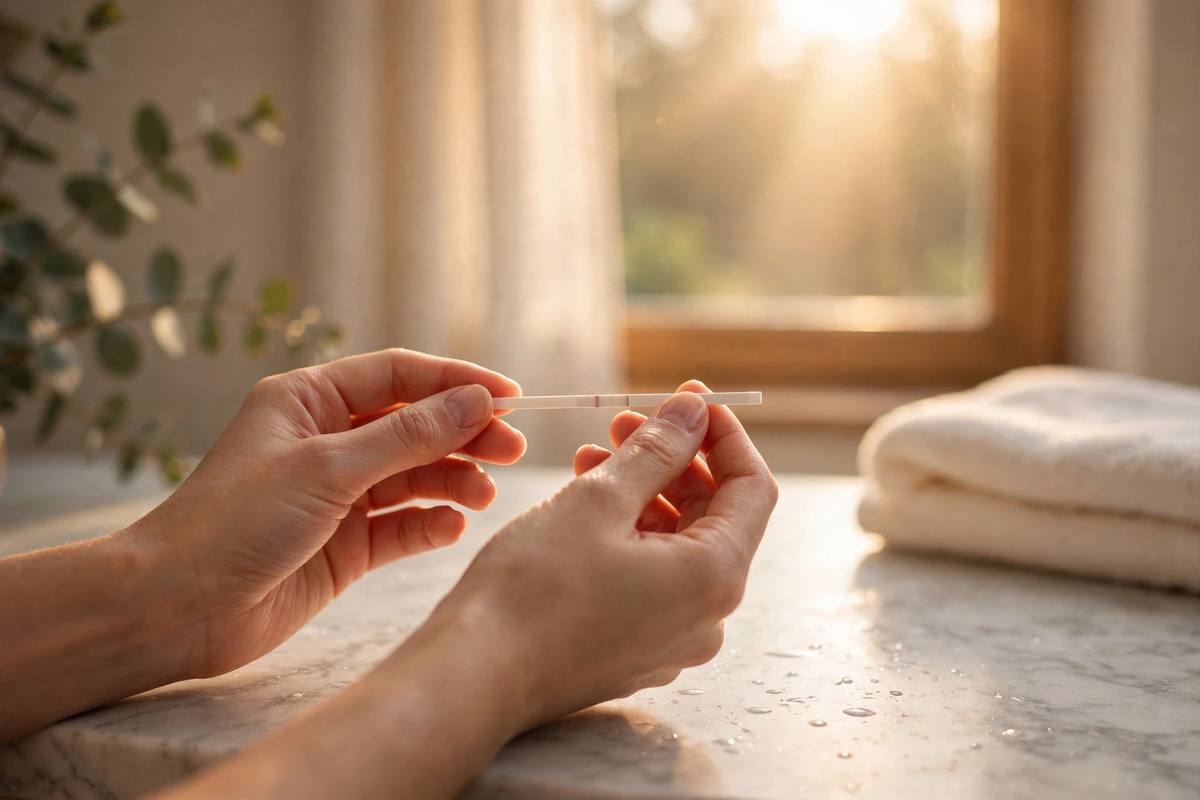
Yes — dollar-store pregnancy tests are accurate when used the way the instructions say. Most detect the pregnancy hormone hCG at 25 mIU/mL, carry the same FDA clearance as drugstore brands, and are 99% accurate from the day of your expected period when you read the result inside the stated time window. Updated 2026: the strip inside a $1 test often comes from the same factories that supply branded tests — the accuracy gap most shoppers imagine simply isn't real. The dollar-store pregnancy test – detects hCG at – 25 mIU/mL, the dollar-store pregnancy test – FDA clearance pathway – 510(k) premarket notification, and the dollar-store pregnancy test – accuracy from expected-period day – about 99% when instructions are followed.
How Sensitive Are Dollar-Store Pregnancy Tests?
Most dollar-store pregnancy tests are sensitive to 25 mIU/mL of hCG — the same detection threshold as many standard drugstore tests, including most store-brand midstream sticks and dip strips. "Sensitive" here has a precise meaning: the lowest hCG concentration at which the test's antibodies reliably trigger a visible line.
hCG stands for human chorionic gonadotropin, the hormone a developing placenta produces after implantation. mIU/mL means milli-international units per milliliter, the standard unit for hCG concentration in urine and blood. A lower number means a more sensitive test — it can catch less hormone.
The numbers across the market, as stated in manufacturer specifications: the dollar-store pregnancy test – detects hCG at – 25 mIU/mL, the standard drugstore pregnancy test – detects hCG at – 20–25 mIU/mL, and the premium early-result test – detects hCG at – 6.3–10 mIU/mL (First Response Early Result reports 6.3 mIU/mL; Clearblue Early Detection reports 10 mIU/mL in their 2024 product specifications). The gap between a $1 test and a $5 store-brand test is often zero — and even the most sensitive early test is a gamble days before a missed period, because the limiting factor is your hCG level, not the strip. If you want to sanity-check a level against published ranges, the hCG level checker maps your number to typical weeks.
Are Dollar-Store Pregnancy Tests FDA Cleared?
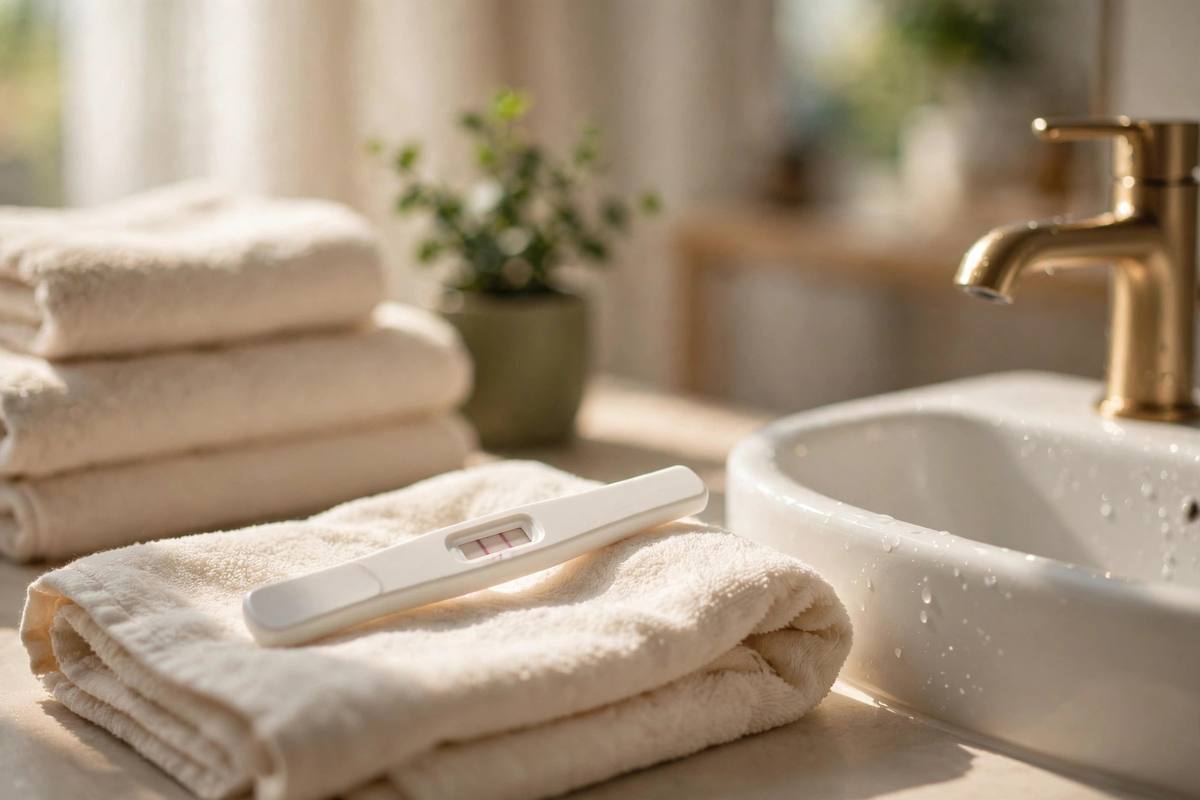
Yes. Home pregnancy tests sold in the United States — including dollar-store strips — are FDA-cleared through the 510(k) premarket notification pathway. This is the regulatory route for moderate-risk devices: the manufacturer must demonstrate substantial equivalence to an already-cleared test, including agreement data against a predicate device.
The exact regulatory facts: the hCG urine test – FDA clearance pathway – 510(k) premarket notification, the cleared pregnancy test – required agreement with predicate device – about 99% from the day of the expected period, and the dollar-store test strip – test format – lateral-flow immunoassay, the same antibody-strip format used by branded midstream tests. "Lateral-flow immunoassay" simply describes how the test works: urine wicks sideways along a strip, and if hCG is present, antibodies bound to colored particles latch onto it and form the visible test line.
One insight most comparison articles miss: many cheap strips and branded tests are produced by the same contract manufacturers — the strip chemistry is effectively identical; what differs is the packaging, the quality of the printed instructions, and the batch-to-batch quality-control variance. That means a dollar-store test in an intact, sealed foil pouch, read on time, is chemically the same experiment as the branded strip. The practical risk with bargain tests isn't the science — it's buying strips with damaged packaging or past their date, which is why checking that pregnancy tests expire is worth the two seconds it takes.
Why Timing Matters More Than the Brand: The Sensitivity Math
Your test can only detect hormone your body has actually made. A test's threshold matters less than the hCG concentration present in the urine sample at the moment you test.
The timeline works like this: the implantation event – occurs – 6–12 days after ovulation, the urinary hCG – becomes detectable – roughly 12–14 days after ovulation (around the missed period), and the urinary hCG – doubles every – 48–72 hours in early pregnancy, per Barnhart et al.'s widely cited 2004 study of hCG curves. Four data points make the math concrete: the hCG concentration – four days before a missed period – typically 10–50 mIU/mL, the hCG concentration – on the day of the expected period – often at or above 25 mIU/mL, the hCG concentration – one week after the missed period – typically in the hundreds of mIU/mL, and the urine sample hCG – after drinking a liter of water – measurably lower than first-morning urine.
Walk through the math with a concrete example. Suppose your hCG is 15 mIU/mL on Tuesday morning — inside the typical 10–50 range for four days before a missed period. A dollar-store test with a 25 mIU/mL threshold reads negative, because 15 is below 25. By Thursday morning, doubling brings it to roughly 30–60 mIU/mL, and the same $1 strip reads positive. That negative-then-positive sequence is not a brand failure — it is the threshold math doing exactly what it should. Even a 6.3 mIU/mL early-result test taken on Tuesday would more likely be positive (15 clears 6.3), yet testing that early remains a coin flip: at these low concentrations, one glass of water or a slightly late implantation can swing the result either way. The information-gain takeaway: buying a more expensive test buys you at most a one-to-two-day earlier answer; waiting two days buys you the same answer for $1. If you are deciding the earliest sensible day to test, run your cycle dates through our when-to-take-a-pregnancy-test calculator rather than guessing.

Can a Dollar-Store Test Give a Wrong Result?
It can — but false negatives are far more common than false positives with any urine hCG test, cheap or expensive. The three classic causes of a false negative are testing before enough hCG has accumulated, diluting the sample with fluids, and misreading the strip.
A false positive is rarer and almost always has an explanation: an evaporation line, a very early pregnancy loss (chemical pregnancy) that produced real hCG, or fertility medication containing hCG. The concrete numbers: the standard test read window – lasts – about 5–10 minutes after dipping, the evaporation line – can appear – 10–30+ minutes after the read window closes, and the hCG trigger shot – can cause false positives for – up to 10–14 days after injection. The evaporation-line caveat is the one competitors understate: as the strip dries, a grayish shadow can form exactly where the positive line would be. Read the test at exactly the stated minute window — usually five minutes — and do not re-read it at 30 minutes. A line that appears at minute 25 is not a faint positive; it is dried urine. If a positive line worries you, our guide on the wrong positive pregnancy test walks through what can genuinely cause one.
One more rare mechanism worth knowing: at extremely high hCG — seen with twins or at later gestations — the strip's antibodies can become overwhelmed and the test can read falsely negative or faint. This is the "hook effect," and it is one reason very high-hCG pregnancies are linked to confusing strip results, as explained in our piece on twins causing a false negative pregnancy test. The fix is the same regardless of brand: retest in 48 hours with first-morning urine.
When Is the Best Time to Take a Dollar-Store Test?
On the day of your expected period or later, using first-morning urine — that is when the 25 mIU/mL threshold is most likely to be met by a real pregnancy.
The timing data behind that advice: the pregnancy test – accuracy from expected-period day – about 99% when the instructions are followed, the first-morning urine – hCG concentration – highest of the day after 4+ hours without drinking fluids, and the urinary hCG – detectable in – roughly 50% of pregnancies four days before the expected period, rising to the high 90s by the day of the missed period (per manufacturer clinical study patterns). In plain terms: testing at night after a day of drinking water is the single most common self-inflicted false negative — if evenings are your only option, hold fluids for at least four hours first, a point our guide to taking a pregnancy test at night covers in detail.
Also non-negotiable with bargain strips: read the wrapper. The cheap dip strip – typical shelf life – 2–3 years from manufacture, and expired antibodies misfire in both directions. Dollar stores turn stock fast, so most strips are fresh — but always check, because a year-past-date strip is the one cheap test that genuinely isn't accurate anymore.
Common Questions About Dollar-Store Test Accuracy
Are dollar-store tests as accurate as First Response?
From the day of your expected period, yes — both are about 99% accurate when used correctly, because both clear their respective thresholds at the same hCG levels. The difference only appears before the missed period: an early-result test with a 6.3–10 mIU/mL threshold can detect roughly one to two days earlier than a 25 mIU/mL dollar-store strip. That earlier window is where the premium price is actually buying something.
Why is my dollar-store test line so faint?
A faint line inside the read window is a positive — it means hCG reached the 25 mIU/mL threshold. Line darkness tracks hCG concentration only loosely, and strip-to-strip variance means two strips dipped in the same sample can look slightly different. If you want to watch the progression, our pregnancy test line progression calculator helps you track how test lines darken across days, which is far more informative than squinting at a single strip.
Should I take two tests to be sure?
Retesting after 48 hours is the reliable move, not doubling up on the same morning. Because hCG doubles every 48–72 hours, a repeat test with first-morning urine settles the question that one borderline strip leaves open. Use the hCG doubling time calculator to see what rise to expect between your two tests.
Can a dollar-store test be wrong if I drink too much water?
Yes — dilution is the most common cause of a false negative. A sample taken after a liter of water can drop hCG below the 25 mIU/mL cutoff even in an established early pregnancy. First-morning urine, after at least four hours without fluids, is the standard for a reason.
The bottom line: a dollar-store pregnancy test is a 25 mIU/mL lateral-flow immunoassay with FDA clearance — chemically the same class of device as the tests sold for five times the price at the pharmacy. Test on the day of your expected period (or later), use first-morning urine, read at exactly the stated minute, and trust the result inside the window. If the line is faint or you tested early, wait 48 hours and retest — and track the progression with our pregnancy test line progression calculator to see the line darken as your hCG climbs.