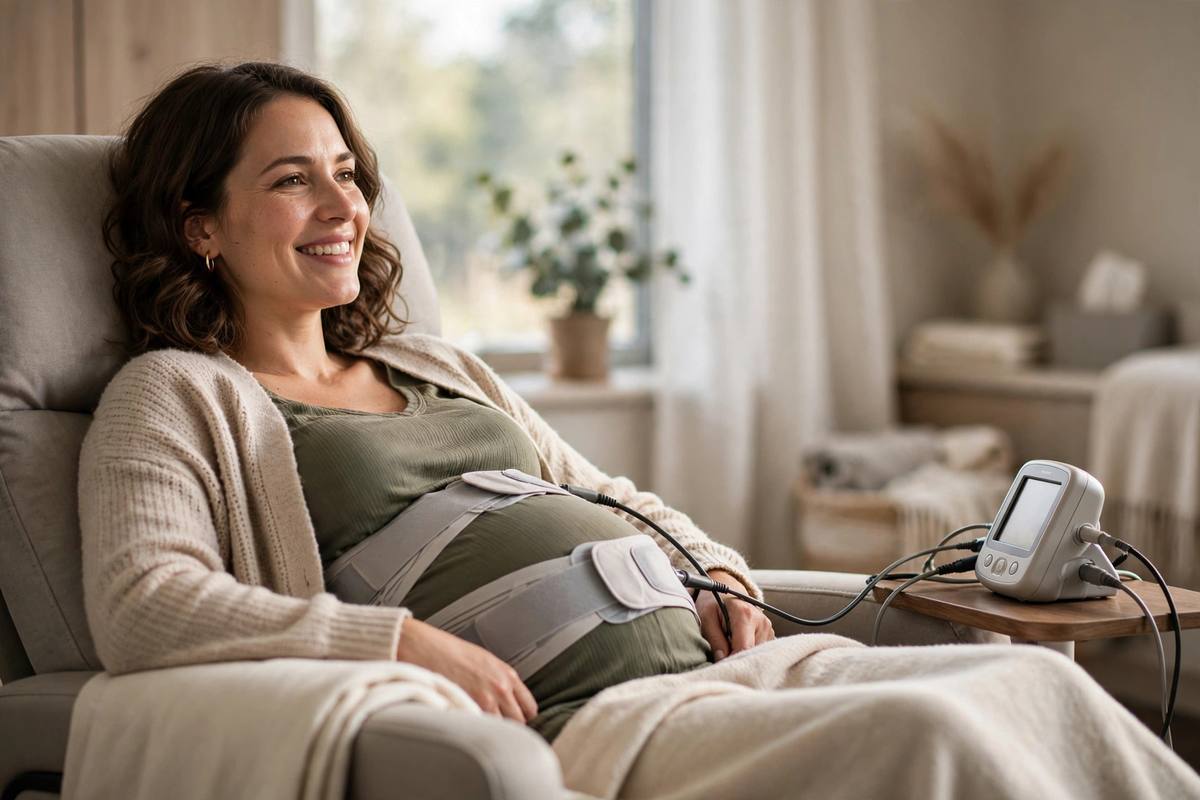
What is a nonstress test in pregnancy? A nonstress test (NST) is a noninvasive way to check that your baby is doing well: two soft sensors rest on your belly for about 20–40 minutes and record the baby's heart rate alongside their movements. A healthy baby's heart rate speeds up when they move — that acceleration is what the test is looking for. No stress is put on you or the baby; the name simply means the test observes the baby at rest, unlike the older contraction stress test that deliberately triggered contractions.
What the Nonstress Test Actually Measures
The NST measures one relationship: fetal heart rate versus fetal movement. Two elastic belts hold transducers against your abdomen — one tracks the baby's heart rate continuously, the other records uterine activity and a button you press each time you feel a kick. The monitor prints both traces on a paper or digital strip, and the clinician reads them together. The test is painless, involves no needles, no ultrasound gel beyond the transducer contact, and no risk to the baby; you typically recline in a chair for the duration.
Why does heart-rate acceleration matter? It reflects a healthy autonomic nervous system. Just as your own heart rate rises when you stand up quickly, a well-oxygenated fetus's heart rate rises with movement — typically by at least 15 beats per minute. A baby whose heart rate responds briskly to movement is demonstrating, in real time, that their oxygen supply and neurological wiring are intact. That is the entire clinical logic of the test, and it is why NSTs are a cornerstone of what ACOG's Practice Bulletin No. 229 (2021) on antepartum fetal surveillance recommends for monitoring at-risk pregnancies.

The 15-by-15 Rule: What "Reactive" Means
An NST result is either reactive (reassuring) or nonreactive (needs follow-up) — and the bar is a precise numbers rule. For pregnancies at or beyond 32 weeks, a reactive NST requires at least two accelerations of the fetal heart rate, each rising at least 15 beats per minute above the baseline and lasting at least 15 seconds, within a 20-minute window. Clinicians shorthand this as "15 by 15." Before 32 weeks, the fetal nervous system is less mature, so the threshold relaxes: accelerations of at least 10 beats per minute lasting at least 10 seconds count.
The baseline heart rate itself also gets checked: a normal fetal baseline runs 110–160 beats per minute. A baseline persistently outside that range, or decelerations (drops rather than rises) in the heart rate, are separate findings the clinician evaluates independently of the reactive/nonreactive call. Knowing how many weeks pregnant you are matters here because it determines which threshold — 15-by-15 or 10-by-10 — your test is judged against.
When NSTs Start and How Often They Happen
NSTs typically begin between 28 and 32 weeks of gestation — earlier only if a specific concern arises — and for high-risk pregnancies they are usually repeated once or twice a week until delivery. "High-risk" in this context is broad: it includes gestational diabetes, preeclampsia or chronic hypertension, carrying multiples, decreased fetal movement, pregnancies past 41 weeks, and maternal age 35 or older, among other indications. Low-risk pregnancies with no complications generally do not need routine NSTs at all.
Timing is not arbitrary. Before about 28 weeks, the fetal autonomic nervous system is too immature to reliably produce the accelerations the test looks for, so results would be uninterpretable — a nonreactive NST at 26 weeks says nothing meaningful. Starting at 28–32 weeks aligns the test with the neurological maturity needed to pass it. If you are tracking the final stretch, our pregnancy week by week guide maps what else happens at each of these late-pregnancy appointments.
What Happens During the 20–40 Minutes
The appointment itself is deliberately low-key. After checking in, you recline — sometimes tilted slightly to the left to keep the uterus off your vena cava — and the clinician positions the two transducers: the heart-rate sensor goes where the baby's heartbeat sounds strongest (found with a quick Doppler sweep), and the contraction sensor sits near the top of the uterus. You hold a small clicker button and press it every time you feel movement.
Then you wait, typically 20 minutes. Many clinics offer juice or a small snack first, because a mild blood-sugar bump often wakes a sleepy baby into an active period — and an active baby is a testable baby. If the trace is quiet, the clinician may use a vibroacoustic stimulator — a small device that emits a brief buzzing sound on your abdomen — to rouse the baby, then extend monitoring to 40 minutes or longer. The whole session usually wraps inside an hour, and you get the result the same day.

A Nonreactive Result Usually Means Your Baby Is Napping
Hearing "nonreactive" is frightening, but here is the insight most guides bury: a nonreactive NST is common, and most babies behind a nonreactive result are perfectly fine. Fetuses cycle through sleep states roughly every 20–40 minutes — and the standard NST window is 20 minutes. Do the math: a routine test has a substantial chance of landing entirely inside a nap, during which the baby barely moves and the heart rate stays flat. The test did not fail; it sampled a sleeping baby.
That is exactly why the protocol does not stop at 20 quiet minutes. Acoustic stimulation plus extended monitoring to 40+ minutes resolves most nonreactive results into reactive ones once the baby wakes. If the trace stays nonreactive, the next step is usually a biophysical profile (BPP) — a 30-minute ultrasound scoring five components (breathing movements, body movements, muscle tone, amniotic fluid, plus the NST itself) out of 10 — or a contraction stress test. Think of the NST as a screening step with a deliberately sensitive trigger, not a diagnosis. Between appointments, daily attention to movement matters too: our kick counter helps you track the patterns your provider will ask about, and see how many ultrasounds during pregnancy to understand where the NST fits among your other prenatal tests.
Nonstress Test vs. Contraction Stress Test
The two tests share a family name but work oppositely. The NST watches the baby at rest and looks for heart-rate accelerations with movement. The contraction stress test (CST) — the "stress" test — deliberately induces mild contractions, via nipple stimulation or a low oxytocin dose, and watches for heart-rate decelerations afterward: a healthy placenta keeps the baby oxygenated through each contraction, while a struggling one shows late decelerations.
In practice, the NST won. It is faster (20–40 minutes versus 1–2 hours), needs no IV or medication, carries no risk of triggering preterm labor, and can be done in an office rather than a labor unit. The CST is now reserved for specific situations — usually when an NST is repeatedly nonreactive and the clinician wants a different physiological angle before deciding on delivery. If your provider mentions either test, the question worth asking is not which is "better" but what each result would change about your care plan.
Warning Signs: When to Call Your Provider
NSTs monitor scheduled risk, but your own observations between appointments matter just as much. Call your provider promptly if you notice a distinct decrease in your baby's usual movement pattern, no movement for two hours when the baby is normally active, vaginal bleeding or fluid leakage, regular painful contractions before 37 weeks, or severe headache, vision changes, or sudden swelling (possible preeclampsia signs). Fetal movement is the at-home version of what the NST measures in the clinic — you are, in a real sense, running a continuous informal nonstress test every day. Early movement questions are common too; many women first wonder whether they can feel baby move at 14 weeks long before any NST is scheduled.
The Bottom Line on the Nonstress Test
The nonstress test is a 20–40-minute, noninvasive check that your baby's heart rate accelerates with movement — at least two 15-beats-per-minute rises lasting 15 seconds each after 32 weeks. It typically starts at 28–32 weeks for high-risk pregnancies, repeats weekly or twice weekly, and a nonreactive result most often means the baby was asleep rather than in trouble. If you are counting down to a scheduled NST, spend the days before it learning your baby's active hours with our kick counter — arriving when your baby is naturally awake is the simplest way to get a clean, reactive result on the first pass.