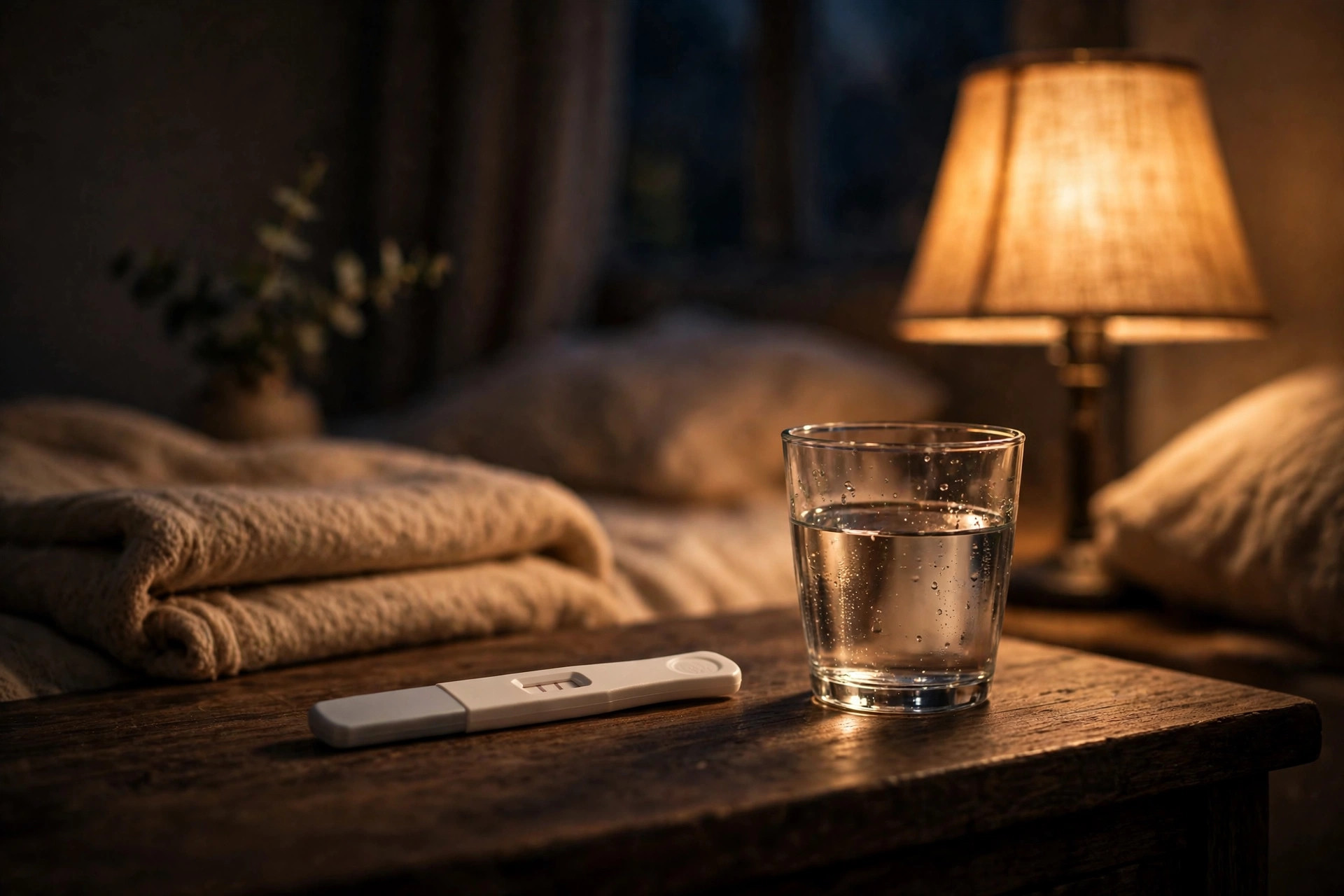
Can You Take a Pregnancy Test at Night? Test Timing and hCG by Time of Day
Yes — you can take a pregnancy test at night, and a positive result at night is just as trustworthy as one in the morning. But a negative result taken at night is less reliable, especially if you are testing early, because your urine is typically more diluted in the evening and contains less of the hormone the test detects.
Home pregnancy tests detect hCG — human chorionic gonadotropin, the "pregnancy hormone" produced by the placenta shortly after a fertilized egg implants in the uterus. The test turns positive when the hCG concentration in your urine reaches its sensitivity threshold, most commonly 25 mIU/mL. First-morning urine — the urine from your first trip to the bathroom after waking, after urine has concentrated in your bladder overnight for 4 or more hours — carries the highest hCG concentration of the day, which is why every major test maker and the FDA recommend it for the earliest, most accurate results.
(Updated 2026: guidance in this article reflects current ACOG, NHS, and FDA advice.)
Does Taking a Pregnancy Test at Night Affect Accuracy?
Yes, testing at night can reduce accuracy — mainly by increasing the risk of a false negative, a negative result when you are actually pregnant. Home pregnancy tests are about 99% accurate when used correctly from the day of a missed period (Clearblue; NHS 2023), but that "used correctly" part matters: the 99% figure assumes urine with an adequate hCG concentration, which first-morning urine provides and evening urine often does not.
Here are the key numbers behind that advice:
- Home pregnancy test – detects hCG at – 25 mIU/mL for most standard brands (Clearblue, store brands).
- First Response Early Result – detects hCG at – 6.3 mIU/mL in laboratory testing (manufacturer data, 2014), making it the most sensitive home test widely available.
- First-morning urine – urine held in the bladder for – 4+ hours overnight, concentrating hCG to its daily peak (FDA guidance, 2005).
- Pregnancy test – most accurate – from the first day of a missed period, with about 99% accuracy when used as directed (NHS 2023; Clearblue).
- Testing 6 days before a missed period – detection rate – as low as 50–76% even with the most sensitive tests (First Response labeling), so early testers are most vulnerable to timing effects.
If you drink a normal amount of fluids through the day, each bathroom trip flushes out concentrated hCG and the fresh urine that accumulates afterwards is weaker. A 2012 analytical evaluation of home pregnancy tests published in Fertility and Sterility found that the real-world sensitivity of over-the-counter tests varies widely and that diluted urine is a leading cause of missed early positives (Cole et al., 2012). The practical takeaway: a faint evening negative deserves a morning retest before you believe it.
Why First-Morning Urine Is the Gold Standard for Early Testing
First-morning urine is the gold standard because hCG accumulates while you sleep. After 6–8 hours without drinking or urinating, your kidneys have produced urine that holds several hours' worth of hCG in a small volume — the highest hCG concentration you will have all day.
- Overnight urine hold – typically – 6–8 hours, versus 1–3 hours between daytime bathroom trips (FDA consumer guidance).
- hCG – produced after – implantation, which happens 6–12 days after ovulation (ACOG, 2023); only then does the hormone begin rising in urine.
That is why package inserts and the FDA specifically instruct users testing before a missed period to use first-morning urine. Once you have missed your period by a week or more, hCG is usually so high that even diluted evening urine stays well above the 25 mIU/mL threshold — and at that point the timing rule largely stops mattering.

If you are unsure whether you are even testing on the right day, our when-to-take-a-pregnancy-test calculator can help you pick the most accurate day to test based on your cycle and ovulation date.
How hCG Levels Rise — and Why the Day Matters Too
The time of day is only half the story: because hCG rises so fast, each passing day changes the picture more than each passing hour.
- hCG – doubles approximately every – 48–72 hours in the first weeks of pregnancy (ACOG, 2023; AAFP).
- hCG – first detectable in blood – about 11 days after conception (NHS), and in urine roughly 12–14 days after conception.
- Blood (quantitative) test – detects hCG from – about 6–8 mIU/mL, versus 25 mIU/mL for most home urine tests (ACOG, 2023).
- hCG – peaks around – 8–11 weeks of gestation, then declines to a stable plateau (American Pregnancy Association; Mayo Clinic).
An hCG level checker can estimate where your hCG level should be on any given day of pregnancy, and an hCG doubling time calculator shows whether two blood results are rising normally.

The Worked Example: Why an 11 DPO Night Test Can Miss What a 14 DPO Morning Test Catches
The gap between a night test and a morning test is bigger than most people expect — and the difference shrinks as pregnancy progresses. DPO means "days past ovulation," the standard way early testers count.
Imagine your hCG is about 50 mIU/mL in concentrated morning urine at 11 DPO — a realistic level, since implantation may have happened only 1–2 days earlier. That morning, a standard 25 mIU/mL test would be positive. But that night, after a day of drinking around 2 liters of water and urinating every few hours, your urine hCG could easily be diluted to one-third of the morning value: roughly 16–17 mIU/mL. That is below the test's 25 mIU/mL cutoff — a false negative, despite a viable pregnancy.
Now apply the doubling rule: at 48–72-hour doubling, that 50 mIU/mL becomes roughly 100–200 mIU/mL by 14 DPO (the day of an expected period with a 28-day cycle). Even diluted to one-third in the evening — about 35–65 mIU/mL — it is still comfortably above the 25 mIU/mL line. A night test at 14 DPO is far more trustworthy than one at 11 DPO. You can watch that darkening pattern yourself with a pregnancy test line progression calculator.
When this rule breaks down: about a week after a missed period, hCG is so abundant that time of day stops mattering much. And at the opposite extreme, extremely high hCG — occasionally seen with twins or a molar pregnancy — can rarely overwhelm a test's chemistry and cause a false negative through the "hook effect." If you have ever wondered whether carrying multiples can confuse a test, read Can Twins Cause a False Negative Pregnancy Test for the full explanation.
Other Reasons a Test Can Be Wrong (Besides the Time of Day)
Testing at night is not the only way to get a misleading result. These matter more than most people realize:
Testing too early
Yes, testing too early is the most common cause of a wrong negative. Implantation happens 6–12 days after ovulation (ACOG, 2023), and hCG needs another day or two to reach detectable levels. Testing at 7 DPO misses the mark even with perfect morning urine, because there is often no hCG in the urine yet. The day of a missed period — about 14 DPO in a typical 28-day cycle — is when standard tests hit their claimed ~99% accuracy (NHS 2023; Clearblue).
Using an expired or mishandled test
Yes, this can mislead you regardless of timing. Pregnancy tests use antibodies that degrade over time and in heat or humidity. An expired test can give false negatives (or ambiguous faint lines) no matter when you use it — which is why it is worth reading the details in Do Pregnancy Tests Expire before you use that leftover strip from last year.
Medications that interfere
Fertility treatments containing hCG (such as Pregnyl or Ovitrelle trigger shots) can cause false positives for up to 10–14 days after the injection (manufacturer labeling; ACOG). Most other medications — including antibiotics, birth control pills, and pain relievers — do not affect home pregnancy tests. False positives from non-medication causes are rare; Can You Get a Wrong Positive Pregnancy Test walks through the real ones, including recent pregnancy loss, certain ovarian conditions, and evaporation lines read after the time limit.
Reading the result too late
Yes, reading too late is a real source of error. Almost all tests specify a result window — usually 3–5 minutes, maximum 10. An "evaporation line" can appear as the test sits and be mistaken for a faint positive. Set a timer and photograph the result inside the window.
How to Test at Night Without Losing Accuracy
If the urge to test strikes at 11 p.m. and you do not want to wait, you can make a night test nearly as reliable as a morning one:
- Hold your urine for 4+ hours. The FDA's advice for concentrated urine translates to evening use: avoid urinating for at least 4 hours before the test so hCG accumulates.
- Limit fluids for 1–2 hours beforehand. Do not chug water to "make yourself go" — dilution is the enemy. A small sip is fine; a liter is not.
- Use the most sensitive test you have. A 6.3 mIU/mL test tolerates diluted urine far better than a 25 mIU/mL one when testing early (First Response, 2014).
- Read it inside the result window, then retest in the morning. Treat an evening result — especially a negative before your missed period — as provisional until confirmed with first-morning urine.
Early Signs Worth Noting While You Wait
Your body may give you hints before a test can confirm anything: breast tenderness and soreness (read What Part of the Breast Hurts in Early Pregnancy to learn what is typical), fatigue, mild cramping, or more frequent urination. Symptoms cannot confirm pregnancy — only hCG can — but they can tell you when a morning test is worth taking.
The Bottom Line
A positive test at night is a positive test, full stop — but do not trust a negative until you have confirmed it with first-morning urine, especially before or just after your missed period. To pick the best day to test for your own cycle, try our when-to-take-a-pregnancy-test calculator.