Does Cramping During Ovulation Mean Pregnancy?
No — cramping during ovulation does not mean you are pregnant. It means ovulation just happened, which is a fertility sign, not a pregnancy sign. Pregnancy-related cramping is a different event: implantation — when a fertilized egg embeds in the lining of the uterus — occurs 6–12 days after ovulation, and its timing and feel are distinct from mid-cycle ovulation pain. This guide was updated in 2026 with current guidance from ACOG, Mayo Clinic, and the NHS.
What Are Ovulation Cramps (Mittelschmerz)?
Ovulation cramps — called mittelschmerz, a German word meaning "middle pain" — are one-sided lower-abdominal cramps that occur around the time an egg is released from the ovary. Mittelschmerz typically starts 12–16 days before the next period, lasts from a few minutes up to 48 hours, and is reported by about 1 in 5 women (roughly 20%), according to Mayo Clinic (2024).
What Causes Mittelschmerz
About 24–36 hours before ovulation, a surge of luteinizing hormone (LH) triggers the dominant follicle to rupture and release its egg. The rupture releases a small amount of fluid and sometimes blood into the pelvis, which can irritate the abdominal lining and cause a brief cramp or twinge. Because only one ovary releases an egg in most cycles, mittelschmerz is usually felt on one side — and the side can switch from month to month.
What Ovulation Cramps Feel Like
Most women describe mittelschmerz as a sharp twinge, a dull ache, or a brief pinch low on one side of the abdomen. The pain is typically mild to moderate and resolves on its own within 48 hours. It often arrives alongside other ovulation signs, such as cervical mucus that turns clear and stretchy and a small rise in libido. If you want to pinpoint your ovulation day more precisely, an ovulation due date calculator can map it from your cycle length.
What Is Implantation Cramping?
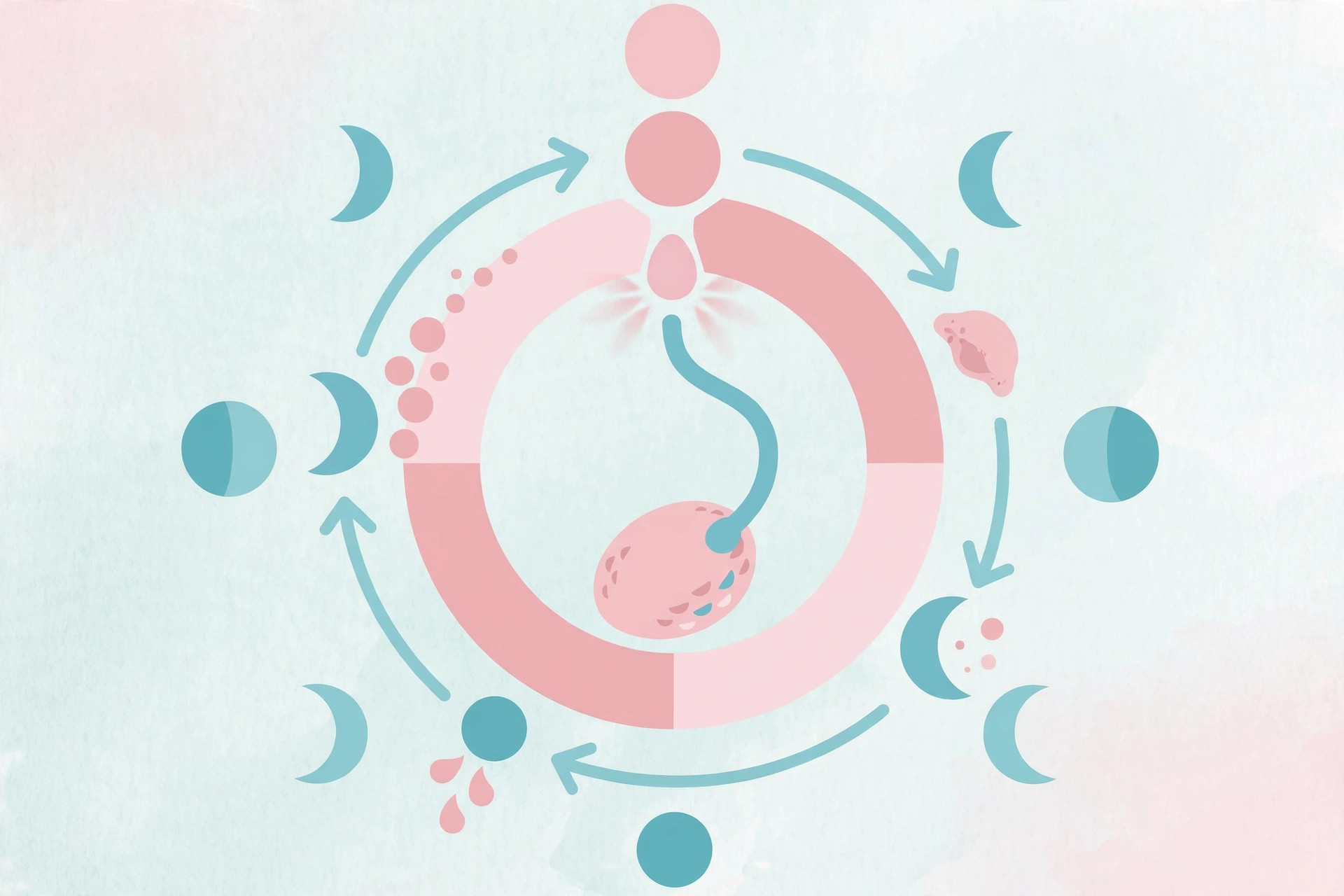
Implantation cramping is mild cramping that can accompany implantation — the process in which a fertilized egg (now called a blastocyst) embeds itself into the lining of the uterus. Implantation occurs 6–12 days after ovulation, most commonly 8–10 days after, and any cramping it causes happens in that window — not on ovulation day.
Unlike mittelschmerz, implantation cramps tend to be duller, briefer, and felt more centrally in the lower abdomen or pelvis rather than on one side. Some women also notice very light spotting around the same time, though most women feel nothing at all during implantation. Because implantation cramping and a very early period can look alike, an implantation vs period calculator can help you compare timing and symptoms before you test.
Why Cramps on Ovulation Day Cannot Be a Pregnancy Symptom
No — cramps on ovulation day cannot be a pregnancy symptom, because on the day you ovulate, pregnancy has not biologically begun. Walk through a typical 28-day cycle to see the timing problem:
- Day 14 (ovulation day): An egg is released and survives about 12–24 hours. Sperm already waiting in the reproductive tract — sperm can survive up to 5 days — may fertilize the egg within hours, but nothing has implanted yet.
- Days 14–18: The fertilized egg divides as it travels the fallopian tube toward the uterus, a journey that takes 3–4 days.
- Days 20–26: Implantation occurs 6–12 days after ovulation. Only after the blastocyst embeds does the body start producing hCG, the pregnancy hormone that tests detect.
- Days 24–28: hCG becomes detectable in blood about 10–11 days after ovulation and in urine about 12–14 days after ovulation, per guidance from the American Society for Reproductive Medicine and the NHS.
So cramps felt on day 14 are roughly two weeks too early to be caused by pregnancy — hCG does not exist in the body yet, and there is no implanted embryo to cause cramping. What the cramp does tell you is genuinely useful: your fertile window is open right now, since the egg is viable for only about 24 hours after release. That is why mittelschmerz is best read as a fertility signal, not a pregnancy symptom.
Ovulation Cramps vs. Implantation Cramps: How to Tell Them Apart
The two types of cramps differ in timing, location, and intensity: ovulation cramps are one-sided and strike mid-cycle, while implantation cramps are more central and arrive 6–12 days after ovulation.
| Feature | Ovulation cramps (mittelschmerz) | Implantation cramps |
|---|---|---|
| Timing | 12–16 days before the next period (ovulation day, give or take a day) | 6–12 days after ovulation, days before a missed period |
| Location | One-sided, low in the abdomen | More central, low in the pelvis |
| Intensity | Mild to moderate twinge or ache | Very mild, often barely noticed |
| Duration | A few minutes up to 48 hours | A few hours up to 1–2 days |
| Associated signs | Stretchy cervical mucus, LH surge | Possible light spotting, rising hCG |
If your cramps arrive mid-cycle on one side, they match ovulation. If mild cramps arrive a week or more after ovulation — especially with light spotting — implantation is the more likely explanation, though a period starting early can feel similar.
When the Rule Breaks Down: Cramps That Are Not Ovulation
The "ovulation cramps are not a pregnancy sign" rule holds when you know your ovulation day. It gets murkier in three situations:
Late or Shifting Ovulation
In irregular cycles, ovulation may occur on day 21 or later instead of day 14. A cramp on day 21 can then be misread as an early pregnancy symptom when it is simply a late mittelschmerz. This is one reason cycle tracking matters: if your cycles vary by more than a few days, anchor your expectations to confirmed ovulation — LH tests or basal body temperature — rather than calendar math.
Anovulatory Cycles
In an anovulatory cycle — a cycle in which no egg is released — mid-cycle cramping can still occur from hormonal fluctuations or ovarian cyst activity, but it is not mittelschmerz and it does not mark a fertile window. Anovulatory cycles are common during perimenopause, while breastfeeding, and in conditions such as PCOS. If mid-cycle pain is a new or recurring pattern for you, it is worth mentioning to your healthcare provider rather than interpreting it yourself.
Other Causes of Mid-Cycle Pelvic Pain
Gas, constipation, urinary tract infections, and endometriosis can all produce cramp-like pain around mid-cycle. Endometriosis-related pain, in particular, can be cyclical and one-sided. If cramps are severe, worsening over months, or accompanied by heavy bleeding, pain during intercourse, or pain with bowel movements, schedule an evaluation instead of assuming ovulation.
When to Call Your Healthcare Provider
Most ovulation and implantation cramps are harmless and short-lived. Call your provider promptly — or seek urgent care — if you experience severe one-sided pelvic pain, especially with vaginal bleeding, dizziness or fainting, or shoulder-tip pain. That combination can signal an ectopic pregnancy — a pregnancy that implants outside the uterus, most often in a fallopian tube — which occurs in about 2% of pregnancies and is a medical emergency, according to ACOG. Also call your provider for cramps with fever, heavy bleeding (soaking through a pad in an hour or less), or pain that keeps worsening instead of easing within a couple of days.
How Long After Ovulation Should You Take a Pregnancy Test?
The earliest reliable time to test is 12–14 days after ovulation — around the first day of your missed period — because hCG needs time to rise to detectable levels in urine. Blood tests can detect hCG a few days earlier, about 10–11 days after ovulation. Testing earlier often produces a negative result even when conception occurred, simply because hormone levels are still too low; a when-to-take-a-pregnancy-test calculator can give you a personalized earliest-test date from your cycle data.
If you do test early and see a faint line, an hCG level checker can help you understand whether your levels are doubling as expected in early pregnancy. Be aware that very early testing has trade-offs: it can reveal a chemical pregnancy — a very early loss that would otherwise have looked like a slightly late period — and expired or faulty tests can mislead, so check the guidance on whether pregnancy tests expire and whether you can get a wrong positive pregnancy test. Once a pregnancy is confirmed, pregnancy symptoms week by week walks through what to expect next, and if cramps continue into those early weeks, Is Cramping Normal in Early Pregnancy explains which kinds are typical and which deserve a call to your provider.

The short version: ovulation cramps are a sign of fertility, not pregnancy. Note when they happen, and once you are past ovulation, give hCG time to rise — then let a well-timed test give you the real answer with a when-to-take-a-pregnancy-test calculator.