Yes — pregnancy tests do expire. Most home pregnancy tests stay reliable for 1 to 3 years from the date they were made, and after that expiration date the test can no longer be trusted to detect pregnancy accurately. The date is not a marketing detail. It marks the point where the chemical strip inside the test may have degraded enough that a real pregnancy could read as negative.
If you found an old test in a bathroom drawer, this guide explains what that date really means, what happens when a test expires, and how to decide whether to use it or replace it. Updated 2026.
What Does the Expiration Date on a Pregnancy Test Actually Mean?
The expiration date on a pregnancy test means the manufacturer can no longer guarantee the test will perform as tested after that month. A home pregnancy test – the stick or strip that detects human chorionic gonadotropin, or hCG, the hormone produced after implantation – works because antibodies on the strip react with hCG in urine. Those antibodies are biological materials. Over time they break down and lose sensitivity.
The Food and Drug Administration (FDA) notes that home pregnancy tests are regulated medical devices and their labeled shelf life is based on stability testing under specific storage conditions (FDA, 2023). Once that window passes:
- Pregnancy test – detection threshold – typically rises above the labeled 10–25 mIU/mL, so low early hCG may not trigger a line
- Pregnancy test – antibody reactivity – declines with age, heat, and humidity
- Pregnancy test – result reliability – is no longer validated by the manufacturer
In other words, an expired test is not suddenly poisonous or guaranteed wrong. It is unvalidated. The strip chemistry has aged beyond the point where the maker tested it.
For timing a fresh test correctly, the When to Take a Pregnancy Test Calculator works out your earliest and most reliable test dates from your last period and cycle length, so you do not waste a good test on a day when even a new one could not work yet.
How Long Do Pregnancy Tests Last?
Most pregnancy tests last 1 to 3 years from manufacture, with many common brands labeled for about 24 months. The exact window depends on the test type and how it was stored.
Shelf Life by Test Type
Shelf life by type varies because the formats protect the reactive strip differently:
- Strip tests (bulk packs) – typical shelf life – 12 to 24 months. The thin strips are cheaper and often sold in multi-packs, but the packaging is less protective once opened.
- Midstream stick tests – typical shelf life – 18 to 36 months. The plastic housing and foil wrap slow moisture and air exposure.
- Digital tests – typical shelf life – 12 to 24 months. The electronics and battery add another failure point in addition to the strip itself.
These ranges assume the test was kept in a cool, dry place. A test stored for two summers in a hot bathroom cabinet may age faster than the printed date suggests.
If you are tracking how a line should darken over several days, the Pregnancy Test Line Progression Calculator explains what darkening can and cannot tell you about hCG rise, and why an expired test makes that pattern meaningless.
What Happens If You Use an Expired Test?
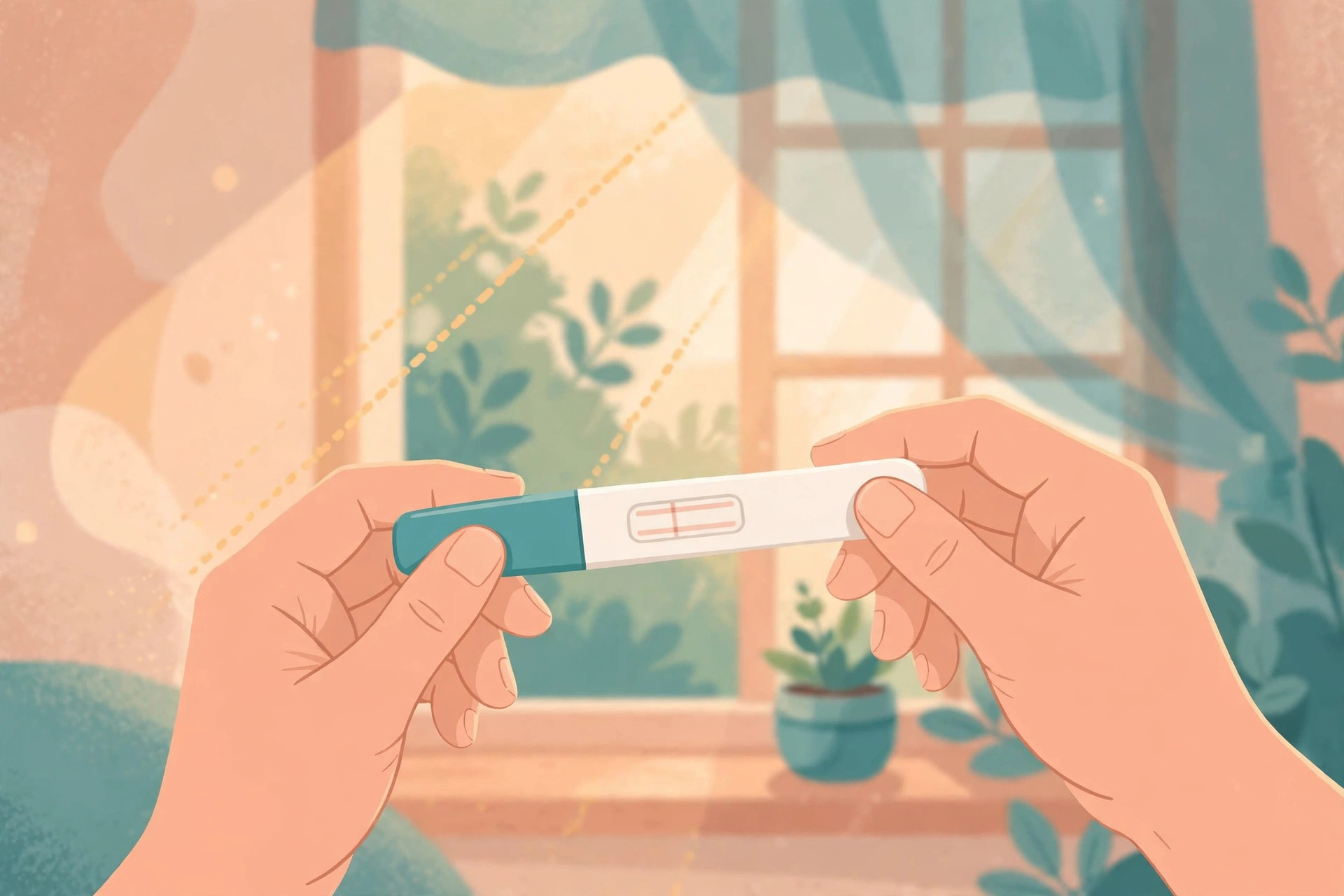
Using an expired test most often leads to a false negative, not a false positive. The degraded antibodies fail to react even when hCG is present, so the control line may appear while the test line stays blank or extremely faint.
Three outcomes are seen with expired tests:
False Negative Is the Main Risk
- Expired test – false-negative risk – increases as sensitivity falls; early pregnancy with hCG of 15–30 mIU/mL is the most likely to be missed
- Expired test – evaporation line confusion – increases, because older strips develop streaks and grey shadows that look like faint positives after the read window
- Expired test – invalid result rate – increases, meaning no control line appears at all
Even in-date tests miss pregnancies when used too early; expired tests add chemical unreliability on top of timing mistakes (ACOG, 2024). A strong line within the read window still likely reflects real hCG, but you cannot judge strength or progression from a degraded strip.
Can an Expired Test Give a False Positive?
A true false positive from expiration alone is uncommon. Faint grey lines after 10 minutes are usually evaporation lines, not hCG. If you get a positive on an expired test, treat it as "possibly pregnant, needs confirmation with a fresh test."
This is also why the distinction matters for very early loss: in What Is a Chemical Pregnancy? Signs, Causes, and What Comes Next, a faint positive followed by a period can reflect a pregnancy that implanted briefly. An expired test blurs that picture, because you cannot tell whether a fading line is falling hCG or a dying strip.
How to Check If a Test Is Expired
To check if a test is expired, find the date printed on the foil wrapper or box labeled EXP, Expiration, or Use By. The date is usually given as month and year, and the test is considered expired at the end of that month.
Where to Find the Date
- Box – expiration location – side or bottom flap, printed in ink, sometimes embossed
- Foil pouch – expiration location – sealed edge, often next to the lot number (LOT)
- Digital test handle – expiration location – underside or wrapper, separate from the battery indicator
Do not rely on when you bought it. If the wrapper is damaged or the foil is torn, treat the test as unreliable even if the date has not passed. If you cannot find the date at all, buy a fresh test rather than guessing.
Does Storage Make a Test Expire Faster?
Yes – heat, humidity, and freezing can make a test unreliable well before its printed date. The labeled shelf life assumes storage roughly between 2°C and 30°C (36°F to 86°F) in a dry place, away from direct sunlight (manufacturer stability data summarized by FDA, 2023).
Storage Conditions That Shorten Shelf Life
- Bathroom cabinet – humidity exposure – high, from showers and steam, the worst common storage spot despite being the most convenient
- Car glove box – temperature exposure – often above 40°C in summer, which accelerates antibody breakdown in days to weeks of cumulative heat
- Freezer or cold garage – temperature exposure – below 0°C, which can damage the membrane and cause invalid results
- Bedroom drawer – storage quality – best for most homes, cool, dry, and temperature-stable
Information gain many guides miss: degradation is gradual and storage-dependent. A test one month past its date from a cool drawer is chemically different from one stored through a humid summer — both are officially "expired," but only one was ever likely to still react. For a result you will act on, a guarantee matters more than a guess.
Can You Still Trust a Result From an Expired Test?
You can provisionally trust a clear positive from an expired test more than a negative, but neither should be your final answer. A negative from an expired test means almost nothing, especially in the first days after a missed period when hCG is still low.
How to Read an Expired-Test Result
- Expired test – strong positive within read window – likely reflects real hCG, confirm with a fresh test within 24–48 hours
- Expired test – negative result – does not rule out pregnancy, retest with an in-date test on or after the day your period is due
- Expired test – no control line – invalid, discard and use a new test
If you have a quantitative blood result to compare, the hCG Level Checker shows where a single beta-hCG value sits for your week, which is far more informative than judging an old urine strip.
And if you used an expired test because you were worried about pain or bleeding, do not let a reassuring-looking negative delay care. As When Does Ectopic Pregnancy Pain Start? Timing & Warning Signs explains, ectopic pain typically starts at 6–8 weeks and needs prompt assessment regardless of what a home test shows. An expired negative in that setting is not reassurance.
What to Do Instead of Using an Expired Test
Buy a fresh test and time it for the day your period is due, when standard tests detect about 99% of pregnancies with first-morning urine. If cost is the concern, a single fresh strip is more valuable than three expired ones.
A practical plan:
- Check the date on every test in the drawer and discard expired or damaged ones so they are not grabbed in a stressful moment.
- Buy one or two fresh tests with at least 12 months left on the date, and store them in a bedroom drawer, not the bathroom.
- Time the test with the When to Take a Pregnancy Test Calculator rather than testing on impulse a week before your period is due.
- Use first-morning urine and read the result inside the window in the instructions – usually 3 to 5 minutes, never after 10.
- Confirm any positive with a second fresh test 48 hours later or a clinic blood test, especially if the first was near its date.
If your fresh test is positive, the LMP Due Date Calculator converts the first day of your last period into an estimated due date, and that date is what your provider will use until an ultrasound refines it.
When to Retest and When to See a Provider
Retest in 2 to 3 days if your period has not arrived and the first test was negative. hCG roughly doubles every 48 hours in early pregnancy, so a borderline test on Monday may be clear by Thursday with a fresh stick.
See a provider promptly if tests stay negative a week after your period was due, if you have a positive test plus one-sided pain, shoulder-tip pain, dizziness, or bleeding heavier than spotting, or if you have had an ectopic pregnancy before. Blood beta-hCG detects lower levels earlier than urine and lets your clinician track the rise.
Expired tests are tempting because they are already there, but a pregnancy test is a chemical measurement and chemicals age. For a decision that matters, a fresh test on the right day is worth more than a free expired one on the wrong day — start with the When to Take a Pregnancy Test Calculator and test once, properly.