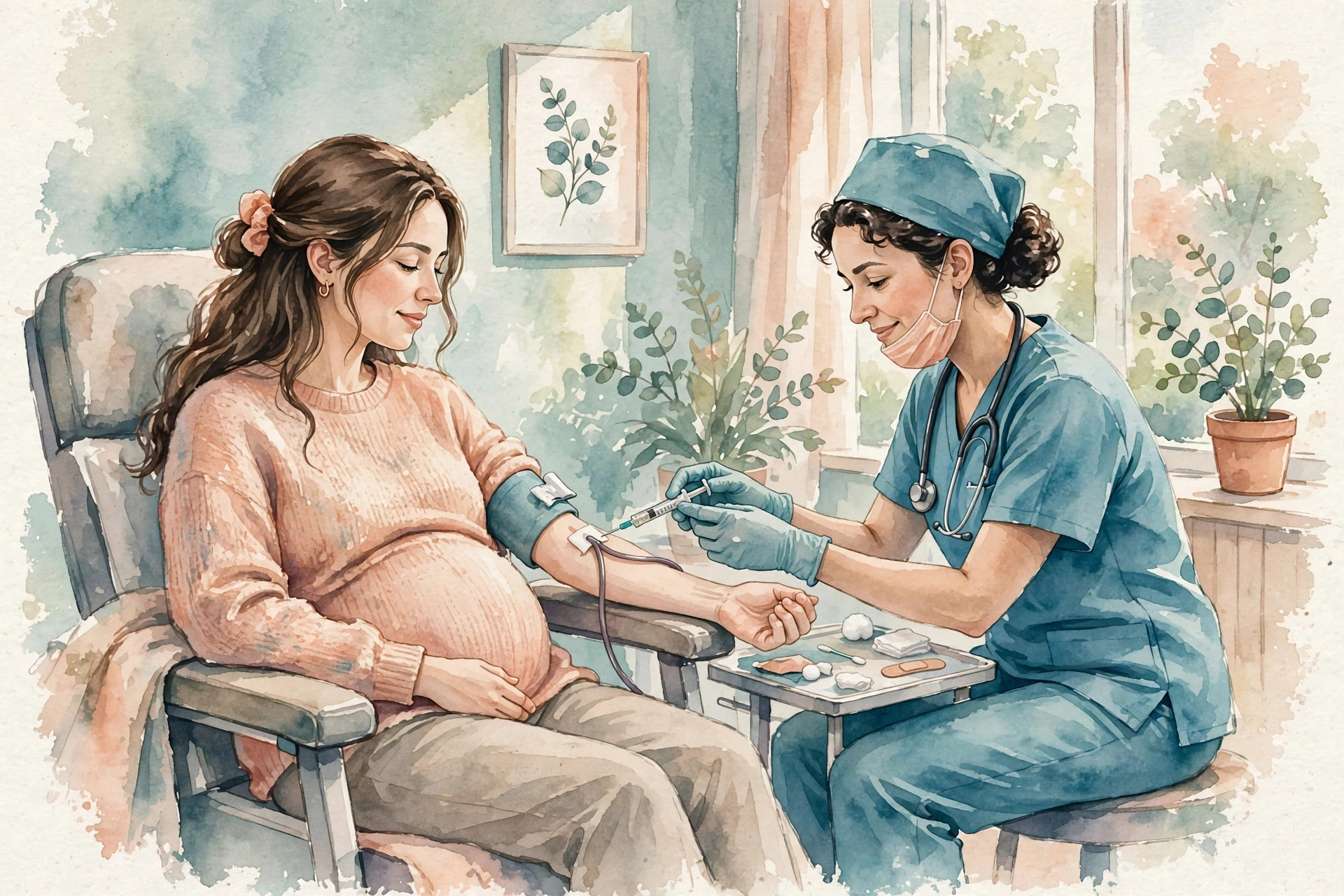
Yes — you can do a DNA test during pregnancy, and the safest option needs only a blood draw from your arm. A non-invasive prenatal paternity test (NIPP) analyses cell-free fetal DNA circulating in the mother's blood and can be done from 7–8 weeks of pregnancy, with accuracy above 99% when the fetal fraction is high enough (ACOG, 2024). Invasive diagnostic DNA tests such as chorionic villus sampling (CVS) and amniocentesis are also DNA tests during pregnancy, but they carry a small procedure-related miscarriage risk and are usually reserved for medical indications. Which DNA test during pregnancy fits you depends on whether your question is about paternity, chromosomal conditions, or a specific inherited disorder.
Can You Do a DNA Test During Pregnancy Safely?
A DNA test during pregnancy is safe for the baby when it is non-invasive, because NIPP – uses – only a maternal blood sample of about 10–20 ml. Nothing enters the uterus, so NIPP – carries – zero procedure-related miscarriage risk. That is the key difference between screening DNA tests and diagnostic DNA tests: CVS – samples – placental tissue at 10–13 weeks through the cervix or abdomen, and amniocentesis – samples – amniotic fluid at 15–20 weeks with a fine needle. Large meta-analyses put the procedure-related loss rate at roughly 0.2–0.3% for amniocentesis and 0.2–0.5% for CVS in experienced hands (Akolekar et al., Ultrasound in Obstetrics & Gynecology, 2015), which is why ACOG (2024) recommends invasive testing mainly when a screening result is high-risk or a diagnostic answer will change management.
If you are simply confirming dates while you plan testing, our hCG Level Checker helps you sanity-check early hormone levels, and the Pregnancy Week by Week guide for week 10 shows what else is happening at the stage when most DNA testing opens up.
When Can a DNA Test During Pregnancy Be Done?
A DNA test during pregnancy can be done from 7–8 weeks for paternity testing, from 10 weeks for chromosomal screening, and from 10–13 weeks (CVS) or 15 weeks onward (amniocentesis) for diagnosis. Timing matters because every DNA test during pregnancy depends on how much fetal DNA is available. Cell-free fetal DNA – first becomes detectable – at around 4–5 weeks, but the fetal fraction – typically reaches – 4% or more only by 10 weeks, the minimum most laboratories require for a reliable screening result (Norton et al., NEJM, 2015). Testing earlier than that is the most common cause of a "no-call" result, where the lab simply cannot extract enough fetal DNA to report.
DNA Test During Pregnancy by Week: A Quick Timeline
- 7–8 weeks: NIPP – becomes possible – for paternity, using the mother's blood plus a cheek swab from the alleged father.
- 10 weeks: NIPT (non-invasive prenatal testing) – opens – for trisomy 21, 18 and 13 screening, with detection above 99% for Down syndrome (ACOG, 2024).
- 10–13 weeks: CVS – provides – a diagnostic DNA result within 7–14 days.
- 15–20 weeks: Amniocentesis – provides – diagnostic karyotype and microarray results, usually within 1–3 weeks.
Not sure how far along you are? The IVF Due Date Calculator is exact for transfer pregnancies, and if early symptoms are confusing you, our guide on whether cramping is normal in early pregnancy explains which sensations are expected at 6–10 weeks.
How Accurate Is a DNA Test During Pregnancy?
A DNA test during pregnancy is over 99% accurate for paternity when the fetal fraction is adequate, and NIPT – detects – more than 99% of Down syndrome cases with a false-positive rate under 0.1% (ACOG, 2024). Accuracy, however, is not one number — it splits by test type. NIPP – compares – hundreds of single-nucleotide polymorphisms (SNPs) between the fetal DNA and the alleged father's sample, so an inclusion result typically reports a probability of paternity of 99.9% or higher. NIPT – remains – a screening test, not a diagnosis: a high-risk NIPT result still needs CVS or amniocentesis confirmation, because confined placental mosaicism (where the placenta and baby have different cell lines) causes most false positives.
Here is the information most comparison pages miss: fetal fraction – rises – with gestational age and falls with higher maternal weight, roughly halving between a BMI of 25 and a BMI of 40 in some cohorts. That means the same DNA test during pregnancy booked at 9 weeks by someone with a higher BMI has a materially higher no-call chance than the identical test booked at 11 weeks. If your first draw comes back inconclusive, a redraw 1–2 weeks later resolves most cases — waiting is a strategy, not a failure.
What Does a DNA Test During Pregnancy Cost?
A DNA test during pregnancy costs roughly $400–$1,800 for private paternity testing, while NIPT – costs – $250–$1,500 out of pocket depending on the panel and insurance coverage in the US (2025 lab pricing). CVS and amniocentesis – cost – $1,000–$3,000 or more, but they are usually covered when medically indicated. Legal (court-admissible) paternity testing costs more than peace-of-mind testing because it requires verified identity checks and an unbroken chain of custody. Home paternity kits bought online cannot be used during pregnancy at all — they need the baby's cheek swab after birth — which is a distinction many shoppers miss until the box arrives.
When a DNA Test During Pregnancy Is Not Recommended
A DNA test during pregnancy is not recommended before 7 weeks, in a vanishing-twin situation without specialist input, or when the alleged fathers are close relatives. A vanishing twin – can shed – DNA into the mother's blood for weeks after the loss, contaminating a paternity or screening result. Related alleged fathers (brothers, or father and son) share so much DNA that SNP panels may not separate them cleanly. Egg-donor and surrogate pregnancies also change the maths, because the circulating fetal DNA is compared against a genetic mother who is not the person whose blood was drawn. In all of these situations, a genetic counsellor should design the testing pathway rather than a direct-to-consumer checkout page.
If you are still in the very early, uncertain stage, you may first want to check whether pregnancy tests expire and can mislead you, and our explainer on what a chemical pregnancy is covers why very early positives sometimes fade before any DNA test during pregnancy is even possible.
The Bottom Line on DNA Testing in Pregnancy
A DNA test during pregnancy is routine, and for most people the blood-based route answers the question with no risk to the baby. Book NIPP from 7–8 weeks, NIPT from 10 weeks, and treat CVS or amniocentesis as diagnostic tools your clinician recommends for a reason. Confirm your dates first with the hCG Level Checker, then choose the test whose timing matches your week — that single decision drives almost all of the accuracy.
How the Lab Actually Runs a DNA Test During Pregnancy
A DNA test during pregnancy starts with sequencing cell-free DNA fragments that are only about 143–166 base pairs long, much shorter than the mother's own DNA fragments. The laboratory first measures the fetal fraction — the share of cell-free DNA that comes from the placenta — and most accredited labs require a fetal fraction of 4% or higher before they will report a result (Norton et al., NEJM, 2015). For paternity testing, the lab then compares several hundred SNP markers between the fetal DNA and the alleged father's cheek-swab sample. For NIPT, the lab counts chromosome fragments instead: an excess of chromosome 21 fragments is what flags a high-risk Down syndrome result. This is why a DNA test during pregnancy reports probabilities and risk scores rather than a simple yes or no — the raw signal is a mixture, and the statistics deconvolve it.
Turnaround time is another practical detail competitors rarely state. NIPP results typically return in 3–7 business days, NIPT screening in 5–10 business days, a CVS karyotype in 7–14 days, and an amniocentesis microarray in 1–3 weeks (2025 laboratory ranges). If you have a decision deadline — for example, CVS must happen by 13 weeks — book backwards from that deadline, not forwards from today. A useful rule of thumb: schedule the blood draw at least two full weeks before any week-based cutoff, so a no-call redraw cannot push you past the window. Twins add one more layer: a DNA test during pregnancy for twins can usually say whether each twin is at risk only when they are fraternal, and paternity testing with twins requires both babies to share the same father for a single combined result.
DNA Test During Pregnancy vs Waiting Until After Birth
Waiting until after birth makes paternity testing cheaper and simpler — a home kit costs roughly $60–$200 and needs only cheek swabs — but a DNA test during pregnancy answers months earlier, which matters for medical planning, legal arrangements, and peace of mind. Postnatal testing also cannot help with the decisions a diagnostic result informs, such as preparing a delivery plan for a baby with a confirmed chromosomal condition. Neither route is morally better; they simply buy the same information at different times and prices. If cost is the deciding factor, ask the laboratory about redraw fees before you book, because a low-fetal-fraction no-call followed by a paid redraw is the most common surprise bill in prenatal DNA testing.