
A domestic rabbit is pregnant for about 31 to 32 days on average, with a normal range of 28 to 35 days from mating to kindling (the birth of the kits). That short gestation — barely a month — is one of the shortest among common pets, and it is why rabbit breeders count days from the mating date rather than waiting for visible signs. Updated 2026, this guide explains exactly how long rabbit pregnancy lasts, what changes week by week, and how to tell a real pregnancy from a false one.
How Long Is Rabbit Gestation, Exactly?
Rabbit gestation lasts 28 to 35 days, and most does kindle on day 31 or 32 after a successful mating. Breed makes a small difference: smaller breeds such as Netherland Dwarfs and Mini Rexes often kindle around day 30 to 31, while larger breeds such as French Lops and Flemish Giants more often reach day 32 to 33. A pregnancy past day 35 deserves a veterinary check, because overdue litters carry a higher risk of stillbirth.
Unlike dogs and cats, rabbits give owners almost no early warning. A doe does not develop an obviously rounded belly in the first two weeks, and many does behave entirely normally until the final week. This is why breeders record the mating date the same day: with a gestation of only about a month, guessing the due date from appearance alone is unreliable. For comparison, see how long a cat is pregnant and how long dogs are pregnant.
Why Rabbit Pregnancy Is So Short
Rabbits are induced ovulators, which means ovulation is triggered by mating itself rather than by a regular heat cycle. A doe does not come into season on a schedule the way a dog or cat does; she is receptive for long stretches and releases eggs roughly 10 to 12 hours after mating. This strategy, documented in veterinary references such as the Merck Veterinary Manual, is one reason rabbits reproduce so efficiently — and why an unspayed doe housed with an intact buck can become pregnant very quickly.
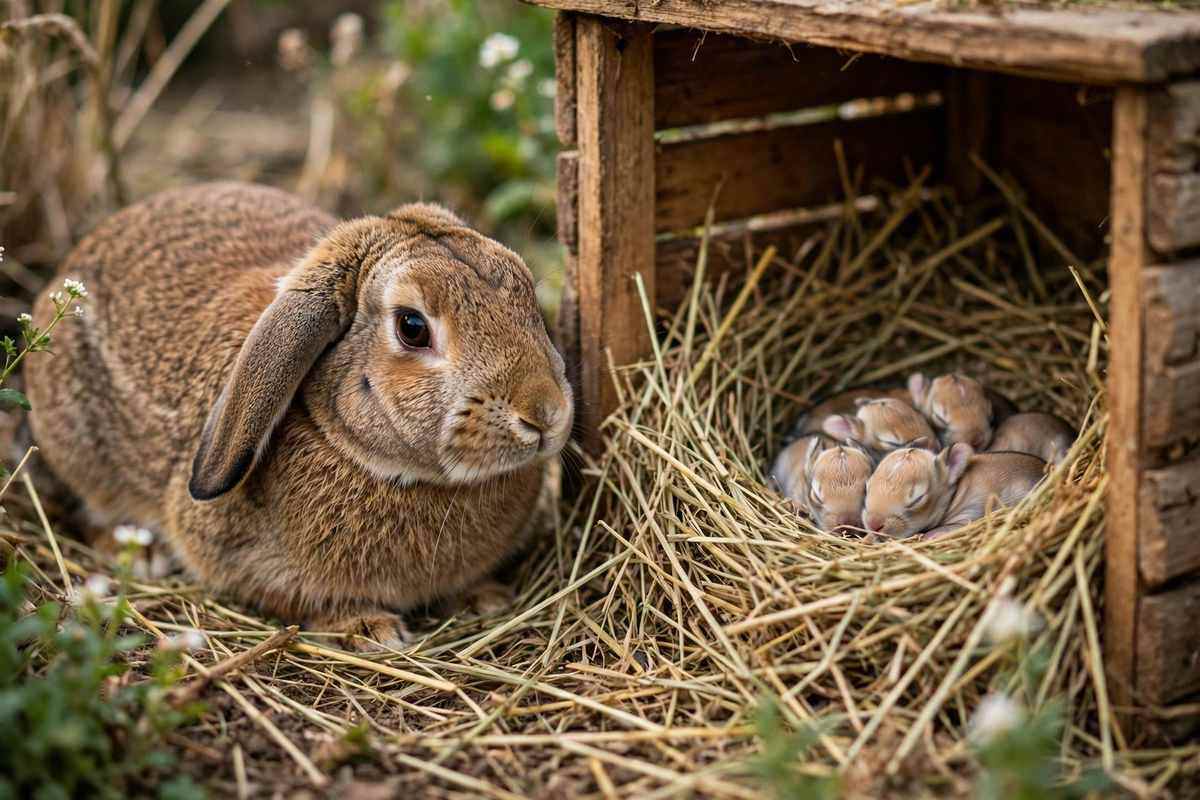
The short gestation also reflects how undeveloped rabbit kits are at birth. Kits are born blind, deaf, and nearly hairless, weighing only about 30 to 80 grams each depending on breed. The doe compensates with extremely rich milk — roughly 13 to 15 percent fat and about 12 percent protein, far richer than cow's milk — so kits often triple their birth weight within the first week. The rabbit strategy is a brief pregnancy followed by intensive nursing, rather than a long pregnancy producing well-developed young.
Signs Your Rabbit Is Pregnant
Pregnancy signs in rabbits are subtle for most of the gestation and unmistakable only near the end. The most reliable early check is abdominal palpation by an experienced handler or veterinarian at around day 10 to 14 after mating, when the embryos feel like small, grape-sized swellings. Palpation before day 10 is unreliable, and rough handling after day 14 risks harming the embryos, so this check has a narrow safe window.
Weight gain is a weaker signal: a pregnant doe typically gains only 100 to 300 grams over the whole pregnancy, spread across the litter rather than concentrated in an obvious belly. In the last 5 to 7 days before kindling, a pregnant doe begins nesting: she gathers hay and straw in her mouth, arranges it in a corner or nesting box, and pulls fur from her chest and belly to line the nest. Fur pulling is the single most reliable at-home sign that kindling is days away, because the exposed skin also makes nursing easier once the kits arrive.
Appetite often shifts in the final week too: some does eat more as the kits' energy demands peak, while others go off food for a day or two just before kindling. Neither change alone confirms pregnancy, but combined with nesting behaviour it is a strong indicator.
Litter Size: How Many Kits to Expect
A typical rabbit litter contains 4 to 12 kits, with an average of about 6 to 8 for most medium breeds. First-time mothers usually have smaller litters of 3 to 6 kits, while experienced does of larger breeds can produce 10 to 14. Litter size also affects gestation length slightly: very large litters sometimes arrive a day or two earlier than small ones, because uterine crowding appears to trigger labour sooner.
Kits are born over a short labour, usually within 15 to 30 minutes for the whole litter, and the doe typically kindles at night or in the early morning when she feels undisturbed. She does not stay with the kits the way a dog or cat mother does: a doe nurses only once or twice a day, for about 3 to 5 minutes at a time, usually at dawn and dusk. This sparse schedule surprises new owners, but it is normal — the milk is so rich that kits thrive on brief feeds, and staying away from the nest reduces the chance of predators finding it. If you are planning a litter, the goat pregnancy due date calculator and our cat pregnancy due date calculator show how other species' due dates are tracked.
False Pregnancy: When Nesting Does Not Mean Kits
False pregnancy, or pseudopregnancy, is common in rabbits and the biggest source of confusion about rabbit gestation. After mating with a sterile buck, mounting by another doe, or even vigorous handling, a doe's body can behave as though pregnant: her progesterone rises, her mammary glands develop, and she may build a nest and pull fur — all without any kits. A false pregnancy lasts about 16 to 18 days, roughly half a real one, then resolves on its own as hormone levels fall.
The practical difference is timing. If nesting appears around day 14 to 18 after mating and then fades with no kits, pseudopregnancy is the likely explanation. If nesting appears in the final week — day 25 onward — and is followed by kindling within a few days, the pregnancy was real. A doe that repeatedly shows false pregnancies may benefit from spaying, which also removes the risk of uterine cancer, common in unspayed does over four.
Rabbit Versus Hare: Why the Difference Matters
Domestic rabbits and wild hares are different animals, and their pregnancies differ. A hare's gestation lasts about 42 days — roughly a week longer than a rabbit's — and leverets are born fully furred, with eyes open, able to move within hours. The longer gestation produces precocial young that can flee predators almost immediately, suiting a hare's open-field life. Domestic rabbits, descended from the European wild rabbit, produce altricial kits that stay hidden in a burrow nest. If a source quotes 42 days, it is describing a hare, not your pet rabbit. The contrast is even starker with the largest land mammals — how long an elephant is pregnant runs to nearly two years.
Caring for a Pregnant Doe
A pregnant doe needs more food, more quiet, and a nesting box at the right time — but not a radical change of routine. Unlimited grass hay remains the base of the diet, with a gradual increase in high-quality pellets during the final two weeks and throughout nursing, when her energy needs roughly double. Avoid sudden diet changes, which risk digestive upset, and never pick a pregnant doe up by her belly.
Place a nesting box in her enclosure around day 28 of gestation, filled with clean hay and straw. Offered earlier, it may simply become a toilet; offered at day 28, she will arrange it herself and line it with fur in the final days. Keep her environment calm in the last week: loud noises, new pets, and cage moves can trigger kindling outside the nest box or, rarely, litter neglect. For other species, the dog pregnancy due date calculator works the same way — enter the mating date and count forward to the due window.
After Kindling: What Happens Next
Kits open their eyes at about 10 days old and begin nibbling solid food at around 3 weeks, while still nursing. Weaning is usually complete by 6 to 8 weeks, and kits should not leave their mother before 8 weeks of age. Responsible breeders also give the doe a rest: although a doe can conceive again within hours of kindling — rabbits can even carry two litters at different stages, a phenomenon called superfetation — back-to-back litters drain her condition and shorten her life. A rest of at least 8 weeks between weaning and re-breeding is the widely recommended minimum, and many breeders rest does for several months.
One point that catches many owners out: a doe that appears pregnant again very soon after kindling may genuinely be pregnant, because postpartum mating is fertile in rabbits. If a buck remains in the same enclosure after kindling, a second litter can arrive about 31 days later, before the first litter is weaned. Separating the buck before kindling avoids surprise litters.
When to Call the Vet
Rabbit labour is usually quick and uncomplicated, but call a rabbit-savvy veterinarian if gestation passes day 35 with no kindling, if the doe strains for more than 30 minutes without producing a kit, if there is bloody discharge before labour begins, or if she stops eating entirely for more than 24 hours in late pregnancy. Dystocia (difficult birth) is uncommon in rabbits, but when it occurs it is an emergency: kits cannot survive long in a prolonged labour, and the doe risks uterine infection. A vet can confirm pregnancy with ultrasound from around day 14 onward, which is safer than repeated palpation for first-time owners.
The Bottom Line on Rabbit Pregnancy
Rabbit pregnancy lasts 28 to 35 days, most commonly about 31 to 32 days, producing a litter of typically 4 to 12 kits that are born blind and helpless but grow fast on their mother's rich milk. The signs to trust are a recorded mating date, palpation at day 10 to 14, and nesting with fur pulling in the final week — and the sign to discount is nesting at day 16 to 18, which usually means a false pregnancy. Keep the doe calm, fed, and supplied with a nesting box at day 28, and rest her properly between litters.
If you are tracking a pregnancy in another pet, our cat pregnancy due date calculator and dog pregnancy due date calculator let you enter a mating date and get an expected due window in seconds — and if you are comparing gestation lengths across species, how long a goat is pregnant completes the picture for small livestock.