Most people stop sleeping on their stomach during pregnancy at around 20 weeks, when the growing uterus makes the position uncomfortable and side sleeping becomes the recommended alternative. There is no single week on which stomach sleeping suddenly becomes dangerous, and no hard ban at one exact date. The change is gradual: stomach sleeping is usually comfortable and safe in the first trimester, becomes awkward in the second trimester, and by about 20 weeks most people switch to their side naturally. Updated 2026, this guide explains the timeline, the blood-flow reason behind the advice, and how to switch comfortably.
When Does Stomach Sleeping Become Uncomfortable in Pregnancy?
Stomach sleeping typically becomes uncomfortable between 16 and 20 weeks of pregnancy, and for most people it is no longer practical by about 20 weeks. The reason is simple physics: as the uterus grows out of the pelvis and the abdomen rounds out, lying face down presses directly on the uterus and feels strained. Some people stop earlier, at 14 or 15 weeks, because tender breasts or an early bump get in the way, while others manage a little longer. Both experiences are normal, and discomfort itself is a reliable signal to change position.
The uterus, the muscular organ where the baby grows, stays tucked inside the pelvis for roughly the first 12 weeks of pregnancy. By about 12 weeks, the top of the uterus, called the fundus, starts to rise above the pubic bone. By about 20 weeks, the fundus typically reaches the level of the navel. That steady growth explains the timeline better than any single cutoff date, and it is also why the point at which you start showing in your first pregnancy varies so much from person to person. If you are unsure how far along you are, a how many weeks pregnant am I calculator can pin down your current week, which makes the 20-week milestone much easier to track.
How the Uterus Grows Week by Week
The uterus grows from about the size of a pear before pregnancy to roughly the size of a watermelon by full term. In weeks 1 to 12, the uterus remains pelvic, so stomach sleeping puts little pressure on it. In weeks 13 to 20, the uterus rises into the abdomen, the bump becomes visible for many people, and face-down sleeping starts to feel compressed. After 20 weeks, the uterus is large enough that lying on your stomach is uncomfortable for almost everyone. Four numbers sum up the story: uterus position at 12 weeks is just above the pubic bone; uterus position at 20 weeks is typically at the navel; stomach sleeping comfort usually ends between 16 and 20 weeks; side sleeping is recommended from around 20 weeks onward.
Why Side Sleeping Is Recommended After 20 Weeks
Side sleeping is recommended from around 20 weeks because it avoids compressing the inferior vena cava, the large vein that carries blood from the lower body back to the heart. The inferior vena cava runs along the right side of the spine, so when a large uterus presses on it, blood return to the heart can fall, which can lower blood pressure and reduce blood flow to the placenta. Sleeping on the left side is usually preferred because it takes pressure off this vein most completely, but sleeping on either side is far better than lying flat on the back for long periods in later pregnancy. This is guidance about blood flow and comfort, not a punishment for rolling over in the night.
The American College of Obstetricians and Gynecologists (ACOG) advises side sleeping in later pregnancy, and the UK National Health Service (NHS) similarly advises sleeping on your side from 28 weeks onward, noting that either side is fine. The difference reflects emphasis rather than contradiction: comfort-based guidance kicks in as the uterus becomes large, while the NHS marker focuses on the later-pregnancy period studied most closely. A widely cited 2019 study by Cronin and colleagues, published in EClinicalMedicine, found that going to sleep on the back in late pregnancy was associated with an increased risk of late stillbirth compared with going to sleep on the side, which is why clinicians emphasise the position you fall asleep in rather than every position you pass through overnight. Two data points anchor this: the uterus reaches the navel at about 20 weeks, when vena cava compression becomes plausible, and sleep-position research has focused on the third trimester, particularly from 28 weeks, when the uterus is largest.
Is It Safe to Sleep on Your Stomach in the First Trimester?
Yes, sleeping on your stomach is generally considered safe in the first trimester, which runs from conception through week 13. During these weeks the uterus is still inside the pelvis, the embryo is tiny, and the amniotic sac and pelvic bones provide substantial protection. No evidence shows that brief stomach sleeping before 20 weeks harms the baby, and ACOG does not advise against it in early pregnancy. The main limits in the first trimester are comfort-related: sore breasts, nausea, and bloating can make face-down sleeping unpleasant long before it becomes a medical question.
It helps to separate sleep position from other early-pregnancy symptoms. If you are wondering whether cramping is normal in early pregnancy, mild cramping from the uterus stretching is common and is a different issue from sleep position. Similarly, a pregnancy symptoms week by week guide can help you tell which new sensations are expected at your stage and which deserve a call to your clinician. Neither cramping nor nausea means stomach sleeping has caused harm.

What If You Wake Up on Your Stomach or Back?
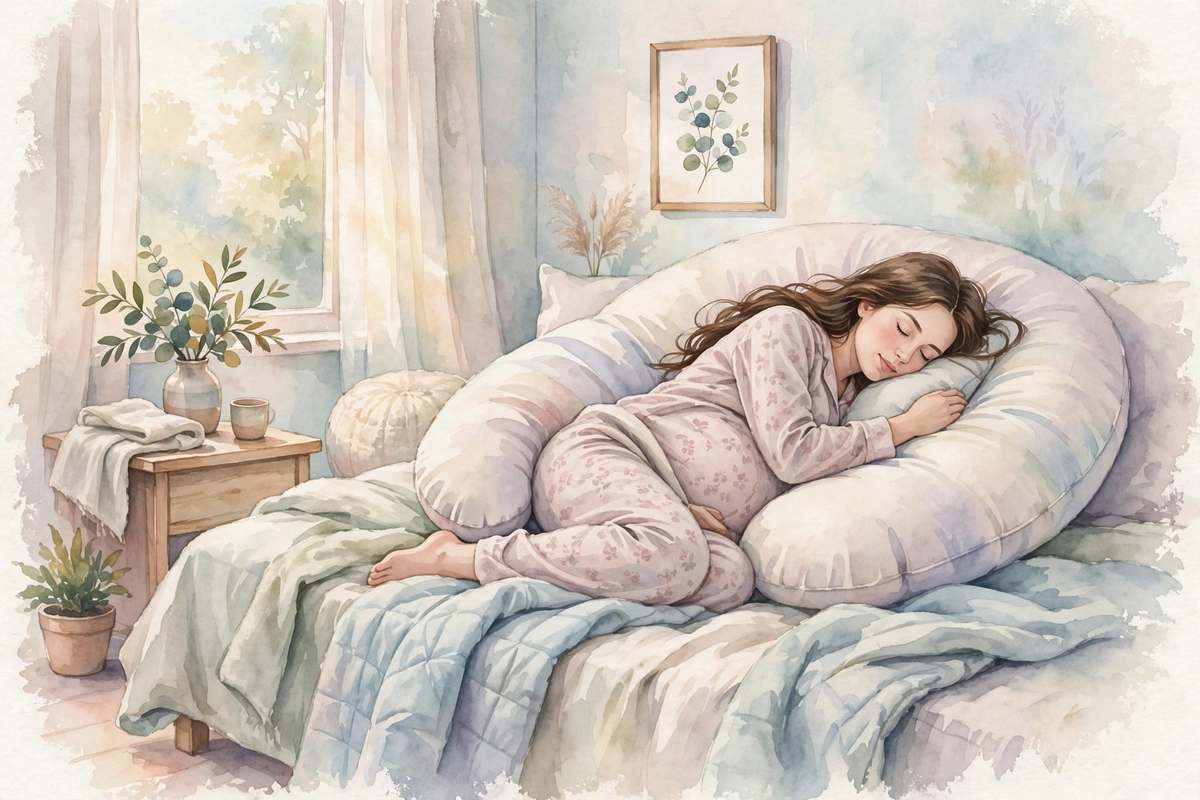
If you wake up on your stomach or on your back, simply roll onto your side and go back to sleep. Waking in another position does not mean you have harmed your baby, and clinicians advise against lying awake worrying about it. Research on sleep position looks at the position you fall asleep in, because that is the position you tend to stay in longest, not at every brief shift during the night. You cannot control your position while you are asleep, and no clinician expects you to. What you can control is the position you settle into at bedtime and the pillows that help you stay there. Start the night on your left side, with a pillow between your knees and another supporting your bump, and place a pillow behind your back to stop yourself rolling fully flat.
How to Switch to Side Sleeping Comfortably
Switching to side sleeping is easier when you change your setup rather than forcing a new habit overnight. Sleep on your left side with your knees slightly bent, which keeps your spine aligned and takes pressure off your lower back. Put a firm pillow between your knees to keep your hips level, and tuck a small pillow or rolled towel under your bump for support. A pregnancy pillow shaped like a U or C can do all of this at once, but ordinary pillows arranged the same way work just as well and cost far less.
Begin practising side sleeping around 14 to 16 weeks, so the new position already feels familiar by the time you need it at around 20 weeks. Keep the bedroom cool and dark, and get up slowly in the morning, since blood pressure changes can cause light-headedness in pregnancy. A pregnancy weight gain calculator can also show whether your gain is tracking within the expected range.
Sleeping Positions to Avoid Later in Pregnancy
From the second half of pregnancy onward, two positions deserve caution: lying flat on your back for long periods, and lying on your stomach once it is uncomfortable. Back sleeping after about 28 weeks is the position with the strongest research concern, because of vena cava compression and its association with late stillbirth in observational studies, and it is the position the NHS advises against for going to sleep from 28 weeks. Stomach sleeping after 20 weeks is mainly a comfort issue, since most people cannot do it for long anyway. Sleeping propped up can help with heartburn, which often worsens in the third trimester. If you notice dizziness or nausea when lying flat, roll onto your side straight away.
When to Talk to Your Clinician About Sleep
Talk to your clinician if you regularly cannot sleep at all, if you snore loudly and wake gasping, if you have persistent dizziness or breathlessness when lying down, or if you notice reduced fetal movement in later pregnancy. Sleep apnoea, where breathing repeatedly pauses during sleep, is more common in pregnancy than many people realise and is worth mentioning, since it is treatable. Likewise, severe back or pelvic pain that stops you sleeping is worth raising, because physiotherapy and support belts can help more than pillows alone. None of these symptoms is caused by one night in the wrong position, but all of them deserve a conversation rather than silent endurance.
The information-gain point most guides miss is this: the stomach-sleeping cutoff is not really a cutoff at all. It is a comfort curve driven by uterine size, and the practical rule is to follow discomfort, start favouring your side from around 20 weeks, and treat side sleeping as the default from the third trimester. People who fixate on a single week either worry too early, switching at 12 weeks when there is no need, or worry too late, feeling guilty about a night spent on their stomach at 24 weeks when discomfort would already have woken them. Trusting the curve, rather than a date, is both more accurate and more reassuring.
To sum up: stomach sleeping is fine while it is comfortable, usually through the first trimester; most people stop at around 20 weeks because it stops feeling good; side sleeping, preferably on the left, is the recommended default from the second half of pregnancy because it protects blood flow through the inferior vena cava; and waking in another position is not a cause for alarm. For a week-by-week picture of what changes next, a pregnancy week by week guide maps each stage from bump growth to sleep and symptoms, so you can see what to expect before it arrives.
If you want to check exactly where you are in this timeline, try the how many weeks pregnant am I calculator and plan your switch to side sleeping from there. And if body changes have you curious about other everyday questions in pregnancy, you may also enjoy reading about whether you can get piercings during pregnancy — another topic where timing and trimester matter more than a single yes-or-no answer.